Get Full Government Meeting Transcripts, Videos, & Alerts Forever!
Get email alerts on the Infrastructure topic
No spam. Unsubscribe anytime.
Council orders 2026 pavement-management reconstruction after residents raise assessment concerns
Summary
After substantial public testimony from Zylon Circle and nearby neighborhoods, the council ordered the 2026 pavement management reconstruction project (2026-101) and approved engineer-estimated assessments and payment options; staff explained estimated per-foot assessment rates and a 10-year roll-on payment option.
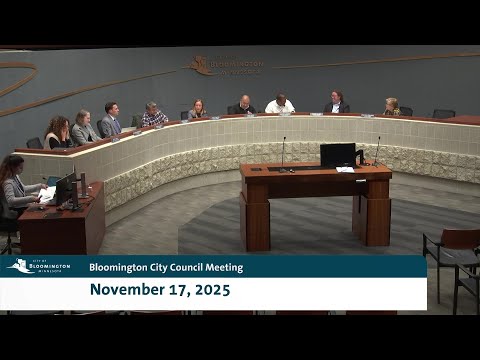
The Bloomington City Council ordered the 2026 pavement-management program (PMP) reconstruct project after a public hearing in which several residents from Zylon Circle and adjacent streets urged the city to consider less intrusive alternatives and questioned assessment estimates.
Engineering staff described the PMP methodology and funding approach: the city uses a pavement-condition index (PCI) to prioritize maintenance and rebuilds several miles per year across reconstruct, overlay and seal-coat programs. Darren Resak and other engineering staff explained that reconstruct work is funded through a mix of special assessments to adjacent properties (about 25% of the reconstruct project cost) and citywide funding sources for the remaining 75 percent, including property-tax debt and utility accounts when relevant.
Staff presented estimated costs and assessment math for the 2026 project: an engineer's estimate put the surfacing component at roughly $3.1 million and the curb-and-gutter component at about $1.9 million. Using the city's adjusted-front-footage method, staff showed estimated surfacing assessment rates of about $47 per adjusted front foot (25% assessed households) and $94 per adjusted front foot for other property types; estimated curb-and-gutter assessment rates were approximately $55 and $110 per adjusted front foot, respectively. Staff emphasized the estimates are preliminary and final assessments will be recalculated after bid results and an independent benefit study.
Several Zylon Circle residents said the street appears in good surface condition and would prefer seal-coat or overlay rather than full reconstruction. Richard Heller said he received an estimated assessment notice for about $4,000 and asked whether resurfacing would be cheaper. Other residents asked why curb-and-gutter would be installed where no curb existed previously and whether that was necessary for drainage. Staff responded that soils and sub‑surface conditions vary across the city and that some streets show sub‑surface distress that merits reconstruct rather than a surface-only treatment; they described a prepayment window (no interest if paid by November 27, 2026), a 10-year spread-on-tax-roll option with an annual 5.5 percent declining interest, and a hardship deferral program for qualifying property owners.
Council members asked technical and policy questions about timing, the assessment policy (25% for single-family 2–3 units, 50% for other properties), and whether delaying work would increase overall costs. Staff said construction-cost escalation raises the risk that deferred projects could be more expensive. City attorneys advised the council that ordering the PMP project requires six affirmative votes; the council adopted the resolution ordering the 2026 PMP reconstruct project and associated street references by a unanimous 6–0 vote after discussion and the public hearing.
Staff said final assessments will be recalculated after bid results and an independent benefit analysis and that the council will review assessments before final levies are placed on tax rolls.