Get Full Government Meeting Transcripts, Videos, & Alerts Forever!
Get email alerts on the Utilities topic
No spam. Unsubscribe anytime.
Council adopts wastewater rate increase and new solid-waste fee structure after public comment
Summary
Following staff presentations and public testimony, the council adopted a 6% wastewater rate increase and an amended solid-waste fee structure that adds an every-other-week option and re-prices cart sizes; the solid-waste ordinance passed 4–2 after residents raised equity and cost concerns.
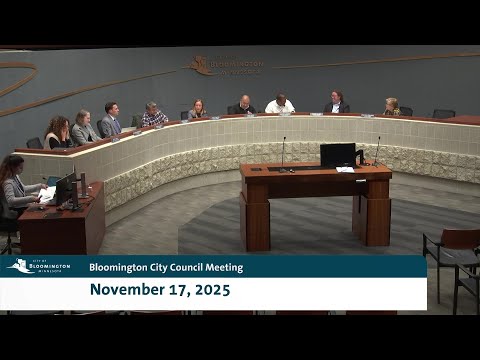
The Bloomington City Council adopted changes to utility rates and solid-waste fees following staff presentations and extended public comment.
Deputy finance manager Carrie told the council the water fund would hold rates flat for 2026 but recommended a 6 percent increase for wastewater to support major capacity work on the North Central sanitary sewer project, which staff estimated at roughly $29 million. “For the wastewater utility, we are proposing a 6% rate increase for 2026,” Carrie said during the utility-rate presentation, adding the proposed rate equates to about $6.01 per 1,000 gallons.
Council opened a public hearing on wastewater rates; after hearing testimony and closing the hearing the council adopted an ordinance amending city code to increase wastewater service rates. The vote for the wastewater ordinance was 6–0.
The council also considered a package of solid-waste changes designed to move Bloomington toward a pay-as-you-throw model. Staff described a new every-other-week small-cart option, a nearly 30% cheaper every-other-week option compared with the small weekly rate for those who choose it, and a roughly 38 percent increase for the large cart. Carrie said the intent is to create incentives for waste reduction and to ensure the pricing structure is financially sustainable under a new collection contract.
Residents at the public hearing urged caution. Matt Larson told the council he felt the large-cart increase was too steep: “To see a percentage go up 38% of anything is out of control,” he said. Council members split in their reactions. Council member D’Alessandro said he supports retaining options that make listening sessions and participation accessible and noted broader transparency concerns in a separate agenda item; Council member Carter and others argued the pricing structure encourages behavior change and would reduce the weighted average cost for many households. Acting Mayor Victor Rivas said he would not support the solid-waste ordinance, citing constituent concerns about burden on larger families and households with special needs.
After debate the council adopted the ordinance amending Chapter 10 and Appendix A to amend solid-waste and refuse collection fees on a 4–2 vote. The council then approved summary publication of the ordinances (voice vote recorded in the minutes). Staff said the large-cart increase is intended to shift cost responsibility toward heavier users and that the city does not use these fees as a revenue source beyond paying hauler and tipping costs.
City staff emphasized implementation details and timelines: the new every-other-week service is scheduled to start in January; residents who sign up by Dec. 15 will receive carts in March; signup options include online, phone, and in-person requests. Staff also noted organics participation currently sits at 32 percent and that projections will be monitored after rollout.
The council’s action alters rate structures and creates new customer choices; staff said they will monitor customer behavior and update projections as the program rolls out.