California agencies outline survivor assistance, confidentiality and eligibility at statewide Victim Resource Panel
Loading...
Summary
State officials from the California Victim Compensation Board, Safe at Home, the Department of Justice and the Department of Social Services described available services, eligibility rules and outreach steps for domestic-violence survivors, and answered questions about federal funding disruptions and practical barriers such as mail forwarding and enrollment.
A statewide webinar hosted by the California Victim Compensation Board on Oct. 28 brought together state agencies to walk survivors and advocates through compensation eligibility, the address-confidentiality Safe at Home program and other resources — and to answer operational questions about enrolling, language access and how a federal shutdown might affect benefits.
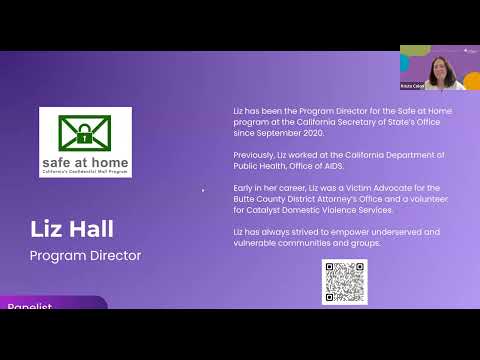
The panel was led by Linda Cueto, executive officer of the California Victim Compensation Board (CalVCB), and moderated by Christa Colon, executive director of the California Partnership to End Domestic Violence. Panelists included Liz Hall, program director for the Safe at Home address-confidentiality program; Victoria Ramirez, victim services manager at the California Department of Justice; and representatives from the Department of Social Services (CDSS).
Why it matters: survivors navigating safety planning, criminal justice proceedings or relocation often rely on a mix of state programs. The webinar sought to clarify what help is available, who may qualify and how to access services without creating additional risk for survivors.
CalVCB: benefits and eligibility Linda Cueto described CalVCB’s role and recent program activity. CalVCB celebrated its 60th anniversary and has assisted roughly 1.7 million victims historically, dispersing approximately $2.7 billion in compensation. In the most recent fiscal year CalVCB received about 7,000 domestic-violence applications and paid roughly $7.2 million to domestic-violence victims.
Cueto said victims generally have seven years from the date of the crime to apply, and minors who live with a victim may qualify until their 20th birthday. "We pay bills that are not covered by any other source, such as insurance," she said, listing relocation costs, lost wages, medical services, mental health treatment and residential security as examples. CalVCB can award up to $70,000 in total compensation per claimant; certain categories carry limits, for example relocation (about $3,418) and additional home security (about $1,000). Application materials and language options are available at victims.ca.gov.
Confidentiality and Safe at Home Liz Hall described the Safe at Home program administered by the secretary of state. The program assigns a substitute mailing address so participants can keep their residential address off public records, and offers mail forwarding, suppression of DMV records, confidential voter registration and, in some cases, confidential name changes. Hall emphasized that enrollment requires working with an enrolling agency — Cal State-authorized community organizations or district attorney offices — and noted the program does not forward packages or medications. "We assign them a substitute mailing address that they can use in place of their actual residential address," she said.
DOJ victim services and language access Victoria Ramirez outlined services available through the Department of Justice’s Victim Services unit, which operates statewide across California’s 58 counties. Ramirez said the unit provides victim advocates, appeal notifications, help with protective orders and referrals to legal assistance, and that services are available regardless of immigration status. "Victim services is here to offer assistance and resources to all victims of crime, no matter their immigration status," she said. The DOJ also uses a language line to make services accessible.
CDSS CalWORKs policy and tools for counties Representatives from the California Department of Social Services described their role implementing CalWORKs domestic-abuse policy, issuing guidance to counties and revising a domestic-abuse training that has not been updated in more than two decades. CDSS said it is working with UC Davis, Mathematica and Parent Voices on listening sessions and anticipates releasing the updated training in 2027. CDSS staff also highlighted the CDSS Domestic Abuse Resource Guide, an interactive county-by-county map of services that the department updates semiannually.
Federal shutdown questions When asked about a concurrent federal government shutdown, CDSS said the department is monitoring cash flow and that CalWORKs operations are expected to continue with "no real significant impact" to processing; however, CDSS staff said issuance of CalFresh benefits was paused for November and counties were advised to coordinate with local food banks and other community resources. CalVCB said its federal Victims of Crime Act (VOCA) grant structure had not yet interrupted current-year spending.
Operational questions from advocates Panelists walked through practical questions from advocates: the CalVCB "advocate portal" allows authorized representatives to view application status and is intended for victim advocates and enrolling organizations rather than direct applicant access. Some enrolling agencies can submit applications through an online portal; applicants themselves generally must work through an enrolling agency. For Safe at Home, parental kidnapping is not an eligible crime under program statute; eligibility is limited to the crimes enumerated in the program law. Because Safe at Home cannot forward packages or medications, staff recommended trusted third parties, postal lockers or local USPS options as workarounds.
Eligibility without police reports Linda Cueto reiterated that charges or prosecution are not required to apply for CalVCB benefits in certain statutory categories (domestic violence, sexual assault, human trafficking, child sexual abuse and certain other categories). In those categories CalVCB may accept documentation other than a police report, such as medical or mental-health provider documentation, consistent with statute and agency guidance.
Resources and next steps The panel recorded the webinar for posting, and panelists pointed to one-page resource guides and the State Victim Coordination Council as ways to find consolidated information about state services. Christa Colon closed the session by thanking panelists and urging continued engagement: "the work to address domestic violence never really ends," she said.
No formal votes or policy adoptions occurred during the webinar; the session focused on explanation, clarification and outreach.