
Waunakee district approves 5.97% property tax levy and directs $2.3M reduction
Get AI-powered insights, summaries, and transcripts
Sign Up Free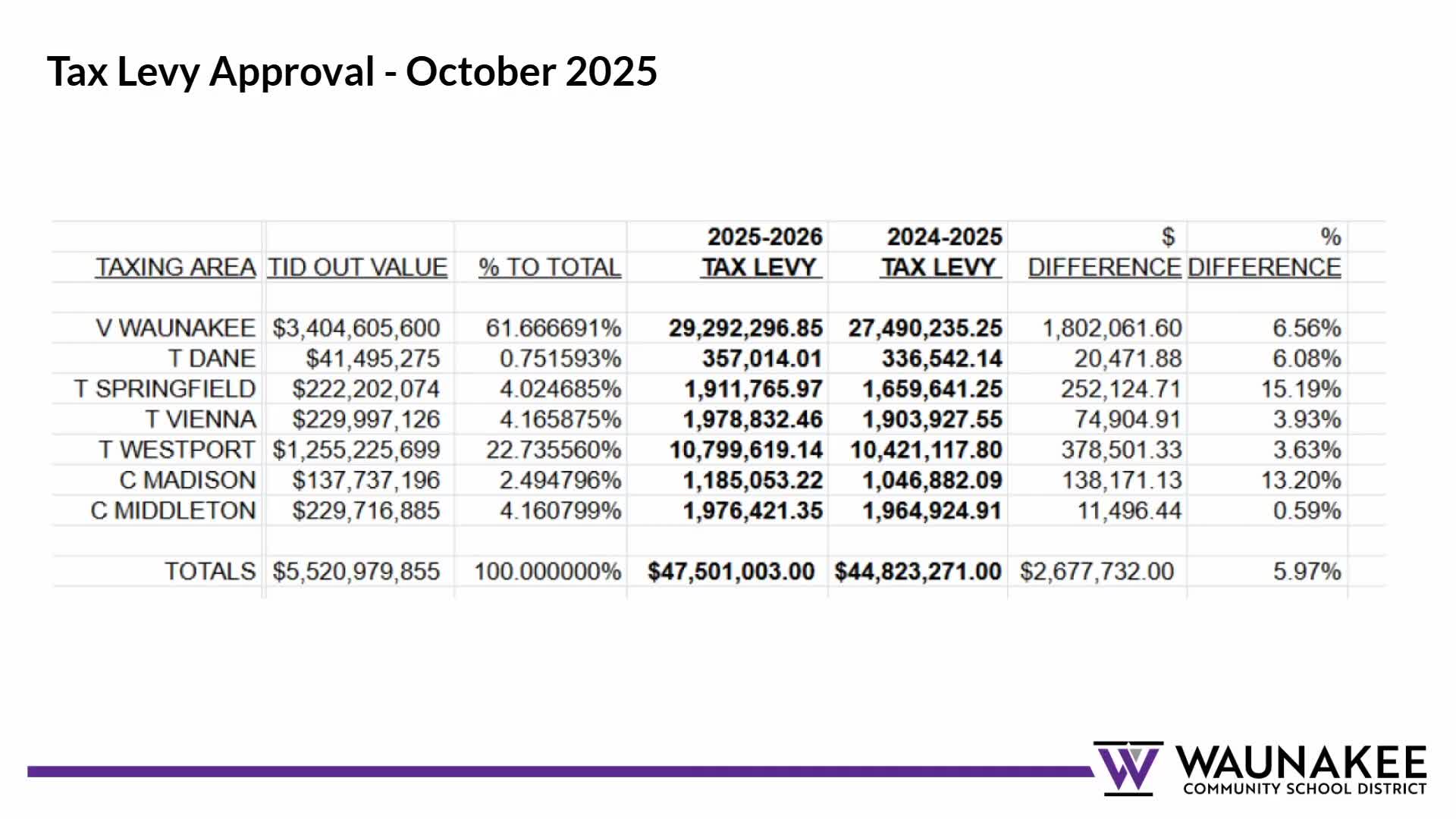
Summary
The Waunakee Community School District approved a 5.97% property tax levy and directed administration to reduce the levy by about $2.3 million; district officials said state budget increases in special-education aid and open-enrollment reimbursements helped offset costs and allowed some reinvestments.
The Waunakee Community School District approved a 5.97% property tax levy and directed administrators to reduce the levy by roughly $2.3 million, district staff said at a school funding informational session. Steve Summers, described in the transcript as "ex executive director of operations," outlined the October board decision and the work the district must still do to cover the removed levy amount.
Summers said the district will explore several options to make up the $2.3 million difference and that the board—s long-term goal is to keep a consistent property-tax levy year over year. He also emphasized that about 3% of district property growth (new property on the tax rolls) moderates the average homeowner—s increase so the typical local levy impact is smaller than the headline levy number.
The presentation credited the July 2025 state budget with producing some net revenue gains for Waunakee: Summers said categorical special-education aid rose to 45% and high-cost special-education reimbursement increased, and added that open-enrollment reimbursement rates increased. As examples, Summers cited about $350,000 in additional open-enrollment revenue, about $400,000 in high-cost special-education aid, and about $660,000 in special-education categorical aid — figures he presented as increases to the district—s spendable revenues.
Summers also said the $325 per-student increase in the state—s revenue-limit formula was funded locally because state equalization aid did not rise, and that some referendum-funded compensation increases implemented in 2025-26 are nonrecurring and expire after the 2026-27 school year. "At the completion of that process, all of our hourly employees in the district will be compensated at a competitive wage for our comparable districts," Summers said when describing referendum implementation.
The board increased a long-standing contingency line from $100,000 to $200,000 and planned other reinvestments funded by state budget changes and reimbursements. Summers noted the district received a clean-energy reimbursement check for more than $1,000,000 and expects a similar reimbursement for the middle school that could "exceed $4,000,000" as the district completes that process.
The district—s October decision to set the levy at 5.97% and direct a $2.3 million reduction leaves administrators tasked with covering the shortfall; Summers said the board and administration will evaluate options in early 2026. Contact information and budget documents are available on the district—s business services webpage, and the district invited community feedback on the coming choices.