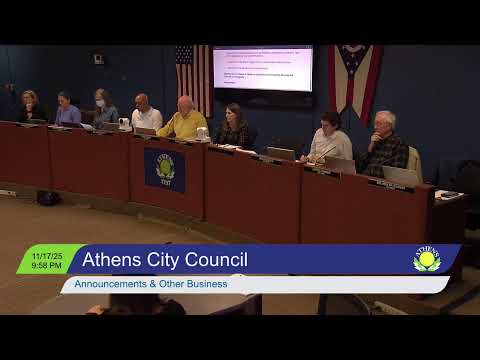
Athens council approves pilot to allow three Conestoga-style micro-shelters at The Gathering Place
Loading...
Summary
After hours of public testimony and debate, Athens City Council approved ordinance 112-25 to allow a one-year pilot placing up to three supervised micro-shelters at The Gathering Place, with annual review and specified safety/sanitation limits enforced by the service safety director.
Athens City Council voted to adopt ordinance 112-25 on Nov. 17, 2025, allowing a narrowly scoped pilot to place three Conestoga-style micro-shelters at 15 & 7 North Congress Street — the property commonly known as The Gathering Place. The ordinance adds temporary housing shelters as a permitted use in the specified R-3 residential zone subject to annual review and operational limits.
Council member Jessica Thomas, who introduced the ordinance, described the principal permitted use as "Temporary housing shelters... commonly known as the Gathering Place and owned by Athens Mental Health Incorporated," and said approvals will include an annual review by the service safety director and may be revoked "for serious safety or sanitation concerns."
Supporters argued the pilot is limited and supervised. Ari Favor, executive director of United Campus Ministry, told the council: "This proposal is not an encampment. It is 3 small insulated micro shelters on a fenced camera monitored block adjacent to an organization that has served Athens for nearly 50 years." Several staff and volunteers from The Gathering Place described case management, screening and daytime services that would accompany the pilot.
Opponents raised safety, code and neighborhood concerns. Resident Jack Stauffer urged caution and criticized council for selecting the downtown parking lot location; he urged tighter rules and clearer metrics for evaluation. Some student speakers and neighbors said they feared increased late-night activity near campus. Council and the law director discussed legal risks related to spot zoning; Law Director Eliason said she had written an opinion noting the spot-zoning concern but acknowledged different perspectives on legal ramifications.
The ordinance defines infrastructure limitations, including a cap tied to proximate restroom facilities, and requires the service safety director to review and renew approvals annually. Council members emphasized supervision and monitoring: members noted visibility from nearby agencies and the presence of cameras and staff. Mayor Patterson said the project is intended as a short-term, highly supervised intervention, not long-term housing, and that council can rescind or revise the authorization after the required review.
Because council recorded the vote as voice votes during the meeting, the formal adoption was announced in session: President Crowell stated "The motion carries and the ordinance is approved." The ordinance text and committee reports specify that approvals may be revoked if the service safety director documents safety or sanitation violations.
What happens next: The ordinance authorizes the pilot and requires annual review; council retained the authority to revisit or rescind the authorization if the pilot fails to meet conditions or creates new public-safety or sanitation problems.