
Panama City adopts phased increase to water and sewer connection fees, rejects geographic split
Get AI-powered insights, summaries, and transcripts
Subscribe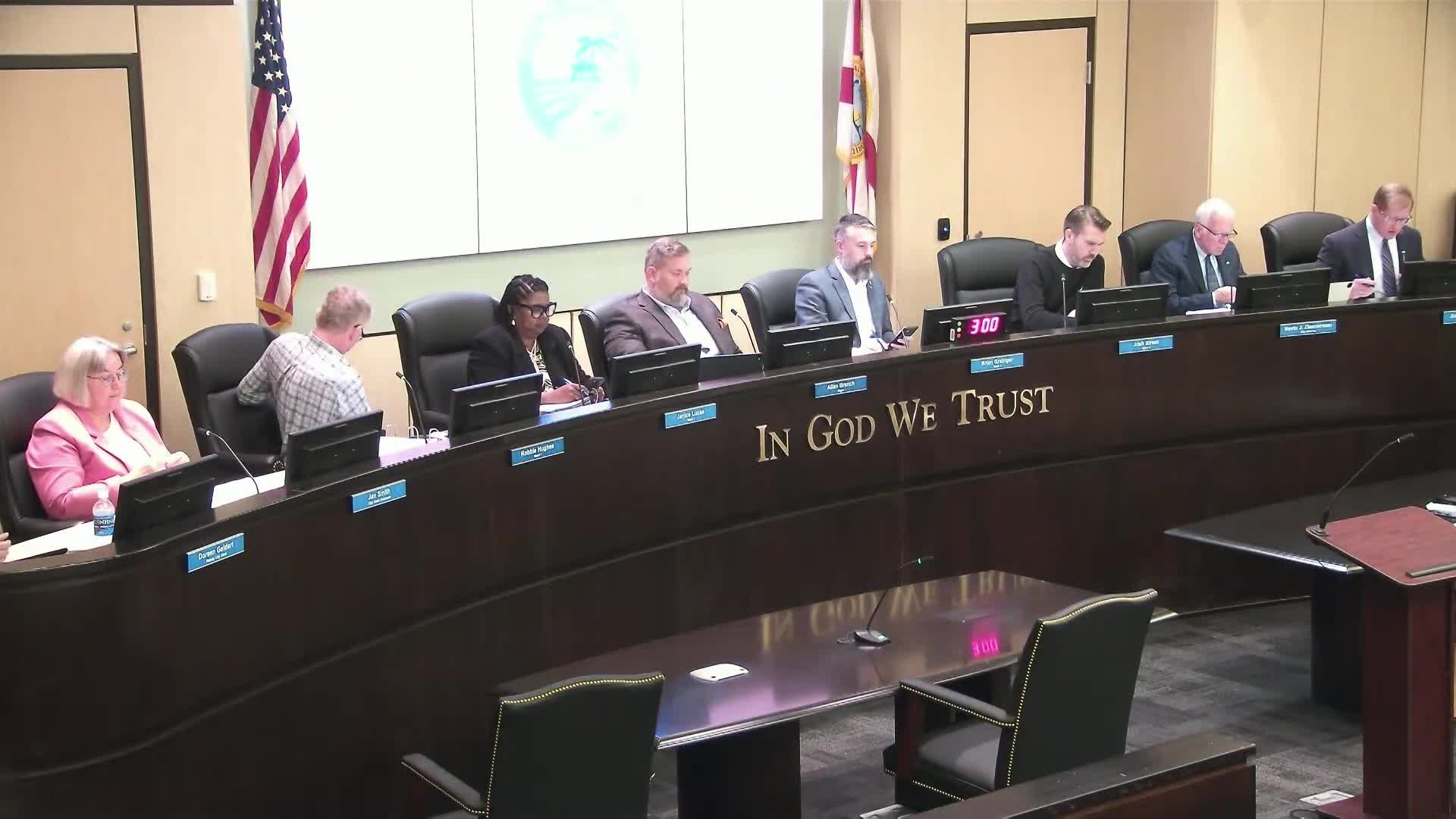
Summary
Panama City commissioners approved ordinance 32‑74 raising water and wastewater connection (impact) fees, phasing the increases (25% on Feb. 16, 2026; 50% Jan. 1, 2027; 100% Jan. 1, 2028) and directing staff to craft assistance for mandated hookups. The commission declined to treat Panama City North differently because a separate study would add significant cost.
Panama City commissioners on Nov. 18 adopted ordinance 32‑74, increasing the city's water and wastewater connection fees and phasing the rises over approximately two years.
The ordinance sets the water connection fee at $1,350 per equivalent residential connection (ERC) and the wastewater connection fee at $1,610 per ERC, with a phased schedule that applies citywide: 25% of the increase effective Feb. 16, 2026 (90 days after adoption), 50% on Jan. 1, 2027 and 100% on Jan. 1, 2028. The roll call vote was 5‑0.
Commissioners said the increase is needed to cover capital investments and to avoid shifting those costs onto monthly utility rates. Staff told the commission the city's connection fees had not been updated since 2003 and that a 2024–25 consultant study recommended the current adjustments.
“Connection fees are collected from new development to recover the city's investment in existing and future capacity that is available to serve growth,” a staff presentation explained, noting the proposal reflects capital costs for existing and new infrastructure.
Commission debate centered on two practical issues: whether to treat Panama City North as a separate service area with different fees, and how to reduce surprise costs for existing homeowners forced to connect. A consultant and staff said breaking the city into two service areas could have a rational basis — for example, longer sewer transmission distances and extra lift stations in Panama City North — but that doing so would require a separate rate study at substantial expense, estimated at roughly $40,000–$60,000. The commission declined to order a new study and instead applied the new fees citywide.
Several commissioners advocated a tiered implementation and payment flexibility to reduce shocks for buyers and existing residents. Commissioners amended the proposal to explicitly phase the increase as described above and directed staff to draft a policy for a tiered assistance approach and disclosure requirements so builders and sellers disclose assessment obligations at closing.
Two members of the public raised equity concerns during the public hearing. Walter P. Andrew (614 Maple Ave.) said many older neighborhoods already have sewer and water infrastructure and argued a flat per‑ERC fee can be unfair to homeowners whose actual connection costs are lower. Derek Thomas (1100 W. 10th St.) said charging all customers the same rate can over‑subsidize large new developments and burden in‑place residents. Commissioners acknowledged those concerns and asked staff to improve visibility of existing assistance programs and to return with implementation details that reduce unintended impacts.
The commission's vote adopts amended language to be codified into the municipal code and sets the effective dates outlined above. The commission also directed staff to develop the mechanics and safeguards for any installment or tiered payment option and to clarify how existing assistance (for example, LHAP/SHIP utility assistance) can be used to offset impacts for qualifying buyers.
Next steps: staff will prepare final ordinance text reflecting the phased schedule and return materials describing assistance and payment‑plan mechanics for commission review.