Get Full Government Meeting Transcripts, Videos, & Alerts Forever!
Get email alerts on the Local Finance topic
No spam. Unsubscribe anytime.
Vigo County commissioners to review new state law that shifts excise and bank-tax distributions to local discretion
Summary
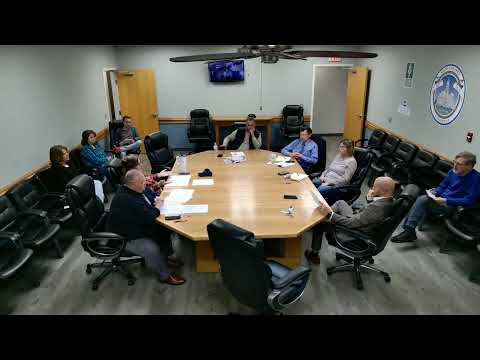
Following HEA 1392, Vigo County commissioners reviewed fall settlement totals for commercial-vehicle excise and financial-institutions taxes, heard staff request keeping current allocations for 2026, and voted to take the information under advisement and meet with department heads before Dec. 10 to finalize allocations.
Vigo County commissioners discussed how a recent Indiana law, House Enrolled Act 1392, changes how commercial-vehicle excise tax (CVET) and financial-institutions tax (FIT) distributions are handled and gives commissioners discretion over allocating the funds.
At the meeting, an Unidentified Speaker 1 told the board that HEA 1392, effective July 1, 2025, amends distribution provisions in Indiana Code 6-6.5-5-20, removing auditors’ responsibility to calculate fund-level allocations and simplifying the process so commissioners receive a pot of money they can direct to lawful purposes. “The commissioners now have the ability to put this money where they deem it's necessary,” the speaker said.
County staff (identified in the transcript as Judy, here listed as Unidentified Speaker 2) explained that, under prior practice, settlements occurred twice a year and the state effectively signaled allocations to towns and local units at settlement. Judy reported fall settlement totals and line items, saying, “for this year, for the fall SIP money, we've got 623,437,” and referenced another distribution figure near $300,200; she cautioned those amounts have been treated as revenue by departments in preparing 2026 budgets.
Officials noted larger aggregate figures in the packet: an Unidentified Speaker 1 cited a total county receipt figure of $21,000,000 and observed that towns such as Riley and West Terre Haute are listed as recipients on the settlement schedules. Line items read aloud included roughly $59,000 to parks and recreation, about $55,000 to the general fund and roughly $52,000 to the health department; smaller allocations to towns and special funds were also noted.
The board discussed audit and tracking considerations. Unidentified Speaker 1 warned that while funds “can be used for any legal purpose,” units must be able to identify the fund receiving the distributions during an audit; placing money in a fund other than general may require a formal ordinance, resolution or vote to reassign it later. Staff additionally reported they were told at a conference that once distributions are placed in a fund they generally must remain there, and that guidance on whether allocations are annual or indefinite was not yet clear.
Given departments had already counted expected receipts in their 2026 budgets, staff recommended allowing the current allocations to stand for 2026 and communicating any changes for planning year 2027. To pursue that path, Unidentified Speaker 1 moved to “take all this information under advisement, work with Judy and Wade to set something up prior to the tenth,” proposing a short meeting with department heads to finalize recommendations; a second was called and the motion passed on a voice vote (“Aye”).
Next steps: county staff will coordinate a meeting with department heads, with the commissioners aiming to finalize allocation decisions before the board’s December 10 meeting. The discussion focused on administrative implementation and budgeting; no reallocation ordinance or formal budget amendment was adopted at this session.