Get Full Government Meeting Transcripts, Videos, & Alerts Forever!
Get email alerts on the Infrastructure topic
No spam. Unsubscribe anytime.
Council declines temporary rail‑corridor pedestrian path; businesses press for other relief
Summary
After extensive public testimony from Seabright and harbor businesses about lost sales, council voted to not proceed with a temporary pedestrian path on Progressive Rail’s corridor citing structural, ADA, lighting and insurability concerns; council will continue to pursue alternative support for impacted businesses and further traffic management options.
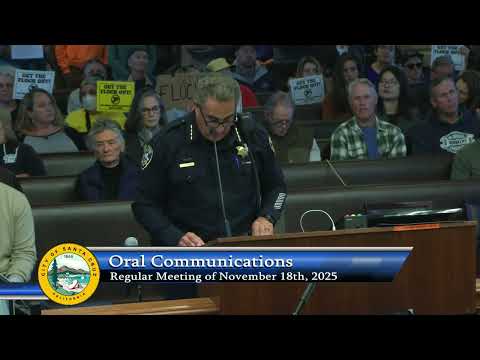
Following lengthy public testimony from Seabright and harbor business owners and residents about revenue losses after the Murray Street Bridge closure, the City Council on Nov. 18 declined to install a temporary pedestrian path on the adjacent rail corridor.
Public Works staff reported that major in‑water work on the seismic retrofit is largely complete for 2025 and that a critical county sewer relocation will be required in 2026 before work can resume. Staff described options explored at council direction: an interim path on the rail corridor, a one‑lane two‑way vehicular signal scheme on the bridge, and other traffic control options. Staff advised that the proposed temporary rail path raised multiple concerns, including ADA compliance on a 3,000‑foot route that would lack the Rail Trail’s permanent lighting and design standards, structural/seismic vulnerability of the trestle, and the city’s inability to secure a separate project insurance policy to underwrite catastrophic liability. Staff also noted Progressive Rail, the easement holder, had declined to permit the temporary path.
Business owners described steep sales declines (estimates commonly in the 17–20% range for the harbor/Seabright businesses), and urged early reopening, two‑way signal options, temporary lighting, and direct financial relief. Several speakers requested city assistance in reaching federal or state representatives.
Council member Bruner moved that the city not move forward with a temporary pedestrian path across the rail corridor, citing health/safety/insurance risks and the legal exposure that would transfer from the RTC to the city if the city constructed the path on the rail easement. The motion was seconded and passed by roll call. Council members and staff emphasized continuing work on alternate mitigation: reopening the bridge to a one‑lane configuration when safe, evaluating the one‑lane two‑way traffic signal option for February when the bridge reopens to one lane, and pursuing business relief measures (loan/assistance programs, marketing/parking strategies and communications).