Get Full Government Meeting Transcripts, Videos, & Alerts Forever!
Get email alerts on the Nitrate Modeling And Targets topic
No spam. Unsubscribe anytime.
State Water Board panel debates modeling choices, A/R metric and interim targets for nitrate in Central Valley groundwater
Summary
An expert panel convened by the State Water Resources Control Board discussed the use of CVSwap and the A/R (applied/removed) metric to set nitrate protection targets for irrigated lands, regional differences in limits, and a 2028 timeline for framework updates.
The State Water Resources Control Board convened an expert panel to review methods for estimating nitrate loading from irrigated lands and to refine targets intended to protect groundwater quality. Panel presenters described coalition-collected field reports and the use of process-based models to translate those reports into actionable protection goals.
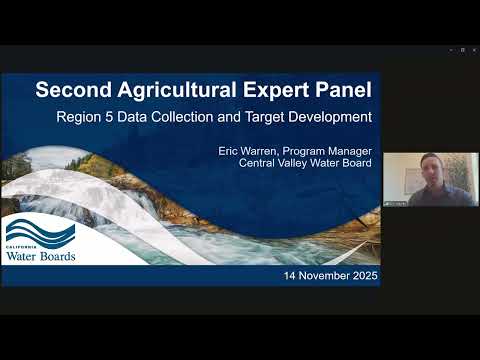
Eric Warren, program manager for Irrigated Lands for the Central Valley, summarized coalition data inputs—including crop type, irrigation reports and nitrogen applied and removed—and said those data feed a QA/QC process before informing district- and region-level estimates. Warren explained the coalition workflow for aggregating field reports and producing the annual and multi-year summaries used by modelers.
Ken Miller, an environmental department staffer who led the modeling presentation, described why the panel is using the CVSwap process-based model for the Central Valley: it simulates large hydrographic systems and allows evaluation of recharge, pumping and assorted hydrologic factors. Miller said the team runs 38-year simulations, drops the first eight years as spin-up, and uses a 30-year average for long-term metrics. He also described the A/R (applied over removed) approach as a practical, reportable metric that many coalitions can implement with farmer-submitted data.
Panelists debated how to convert model outputs into policy. Several experts pushed for region- and crop-specific treatment rather than a single absolute per-crop limit. The panel discussed percentage-based interim targets (examples of 80–90% were raised), multi-year averaging (three years was commonly recommended), and the treatment of isolated fields or fields that change ownership or cropping patterns. Panel members repeatedly emphasized that targets must be agronomically viable and that an interactive, iterative process with growers would be required to set defensible objectives.
Panel staff said the framework is on a five-year review cycle and that the next major update is targeted for completion by 2028. Staff also noted legal and procedural constraints on collaborative live-editing of drafts, which influences how quickly versions can be produced and circulated for comment.
The meeting produced no formal votes. Instead, the panel identified outstanding technical gaps (denitrification data, volatilization rates and coefficients for some crops) to be addressed in follow-up work and assigned authors to consolidate comments before the next meeting. The board will continue deliberations at scheduled public sessions, with a draft revision expected ahead of the December 5 meeting.