
SCE and PG&E advocate engineering‑guided decision rules, scenario inputs and local engineering judgment
Get AI-powered insights, summaries, and transcripts
Subscribe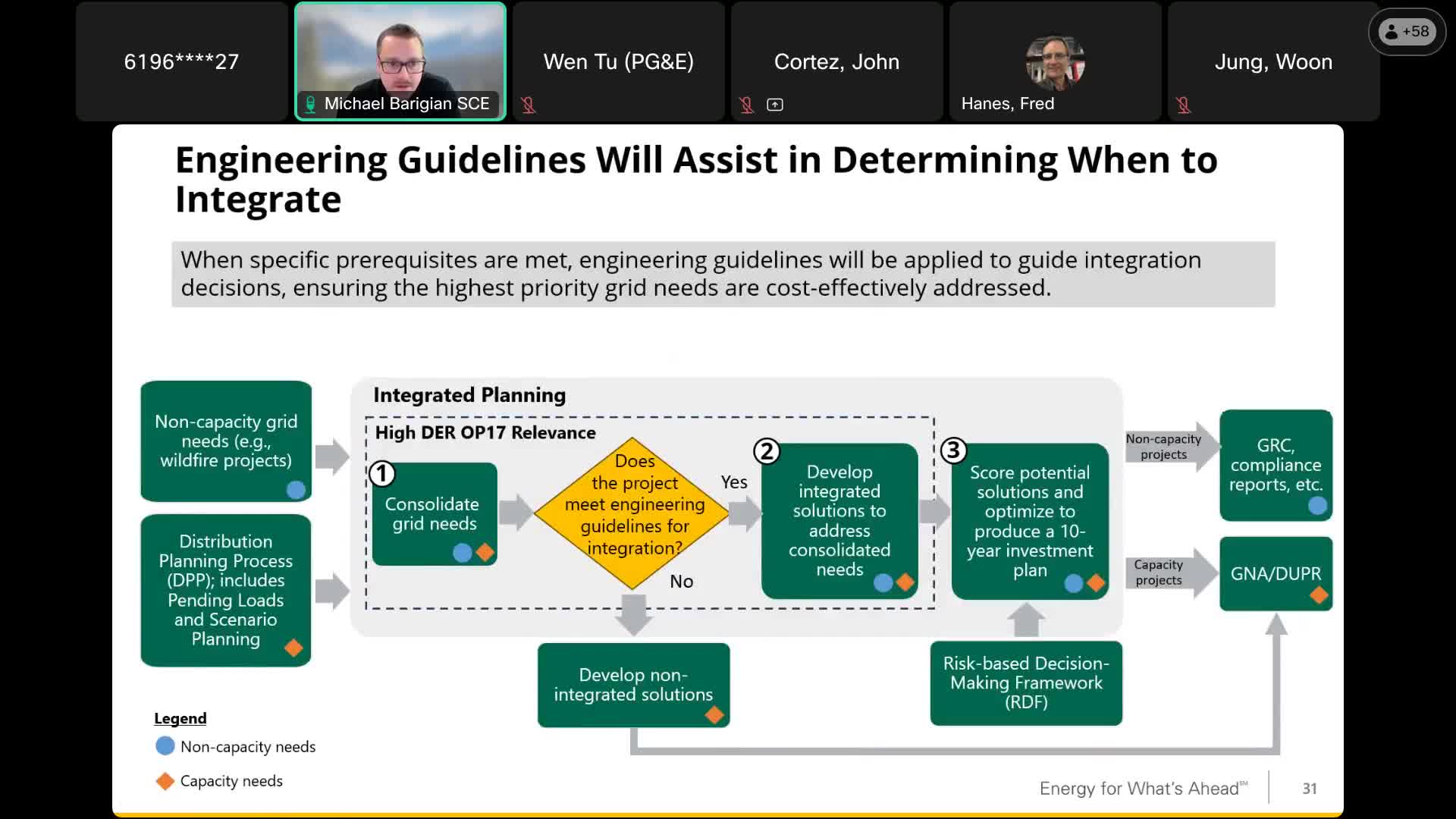
Summary
SCE proposed an engineering ‘decision diamond’ that consults pending‑load and scenario planning outputs; PG&E emphasized engineer‑led decisions grounded in standards and ESOP economic analysis, with varied corner cases requiring project‑specific review.
SCE and PG&E used the CPUC workshop to describe how engineering guidelines and upstream planning outputs would guide integrated‑planning decisions.
SCE proposed a geospatial consolidation of capacity and noncapacity needs followed by a decision diamond that uses engineering guidelines to determine whether to develop a single holistic integrated solution or to proceed with separate conventional projects. Michael of SCE said integrated planning will not change the role or conclusions of the RDF; RDF remains an input to the optimization stage.
SCE emphasized pending‑load classification and three‑scenario planning as the vehicles for encoding the probability a capacity need will materialize. "We believe the probability of a capacity need occurring is adequately addressed in... categorization of pending loads... and the detailed decision logic applied within scenario planning," Michael said.
PG&E’s Brad Dugan described local capacity planning engineers using 10‑year forecasts, design standards and an internal economic tool (ESOP) to evaluate whether installing larger assets now is justified on a net present cost basis. PG&E said many sizing options are standardized in its manuals and that engineers must also consider constructability, permitting, timing and material lead times.
Both utilities said guidelines are intended to streamline common decisions and free constrained engineering resources; they also warned guidelines will not cover every corner case and that exceptions will require documented engineering judgment and, where appropriate, further analysis or reporting.
Stakeholders asked how low‑confidence pending loads are treated in decisions and whether utilities will track avoided costs when choosing not to pursue integrated alternatives. SCE and PG&E said the pending‑load categorization and scenario decision logic will feed a single investment plan into the integrated planning process; utilities also offered to follow up in writing on advanced conductor standards and material codes.
The Energy Division asked parties to file questions/comments to the proceeding service list by Dec. 2; IOUs were reminded to file tier 3 advice letters by Dec. 15, 2025.