
California utilities outline integrated‑planning guidelines, urge engineer judgment and scenario inputs
Get AI-powered insights, summaries, and transcripts
Sign Up Free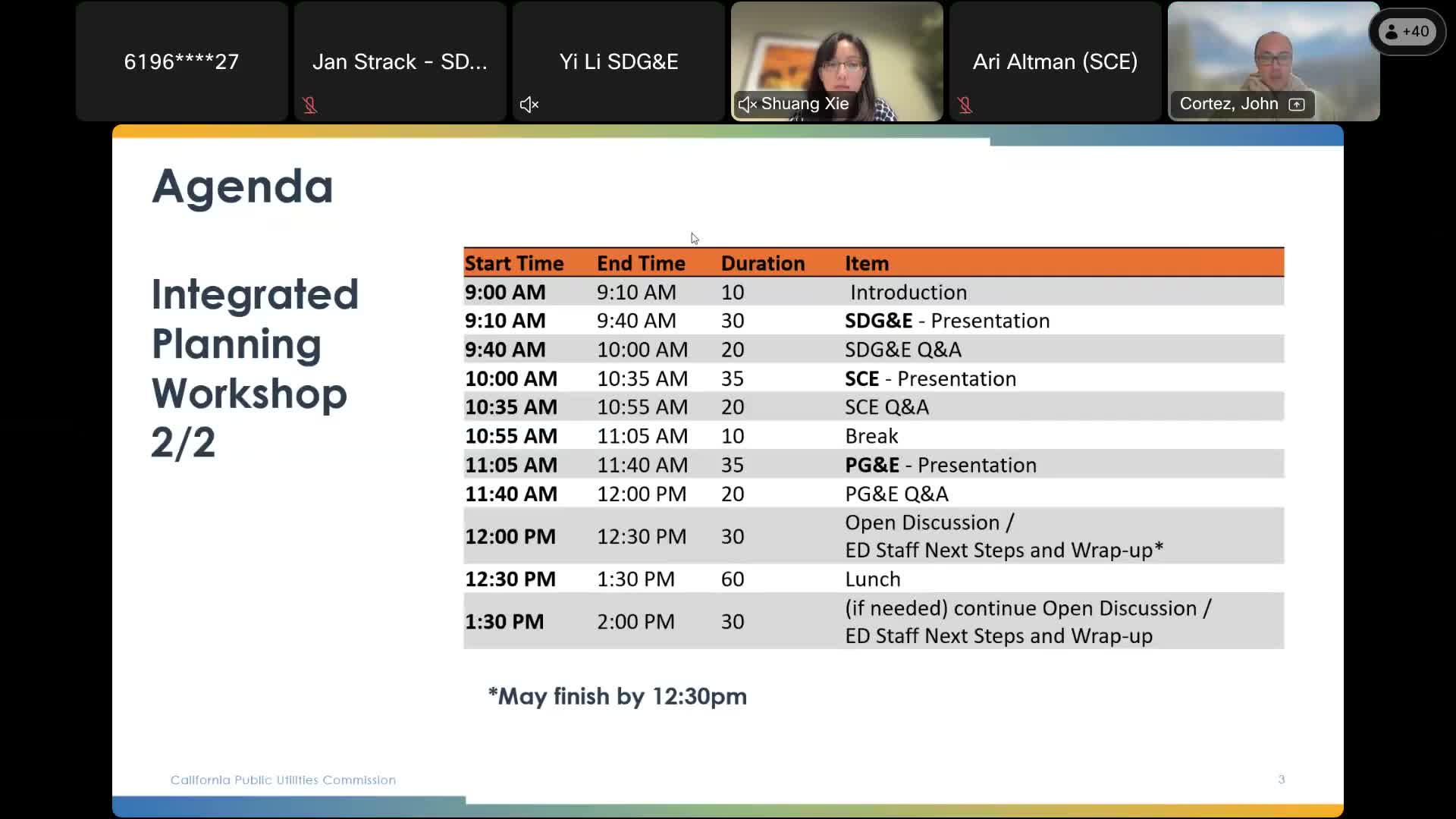
Summary
At a CPUC workshop, SDG&E, SCE and PG&E presented integrated planning proposals that use engineering guidelines, pending‑load categorization and scenario planning to decide when to ‘upsize’ infrastructure now rather than later; IOUs said upsizing is often cheaper than repeating work and Energy Division set advice‑letter deadlines.
San Diego Gas & Electric (SDG&E), Southern California Edison (SCE) and Pacific Gas and Electric (PG&E) presented competing but related approaches to “integrated planning” at a California Public Utilities Commission Energy Division workshop focused on ordering paragraph 17 of Decision 24‑10‑030. The utilities described methods intended to help decide when to add capacity earlier — for example, installing larger conductors when performing required wildfire‑hardening or other noncapacity work — to avoid redoing work later.
Energy Division moderator John opened the session by noting the goal: collect IOU proposals and stakeholder feedback ahead of tier 3 advice letters due Dec. 15, 2025. SDG&E, SCE and PG&E each said their proposals do not change core planning processes such as the risk‑based decision‑making framework (RDF) or general rate case (GRC) reporting; instead they aim to apply engineering guidance to the outputs of distribution planning.
SDG&E’s presenters emphasized cross‑functional coordination at their scale and offered an illustrative cost comparison showing that doing one larger undergrounding project now could cost roughly $2.5 million versus about $4.7 million if the work were performed twice in two separate years. Jan Stack of SDG&E said the example was conceptual but intended to show “why the best solution would be” to do the larger upgrade at once.
SCE presented a “decision diamond” that would apply engineering guidelines to geospatially consolidated capacity and noncapacity needs. Michael, SCE’s senior manager for grid policy (standing in for other presenters), said the utilities will use pending‑load categorizations and three‑scenario planning to capture the probability a future capacity need will materialize before deciding whether to advance capacity work.
PG&E’s presentation stressed that local capacity planning engineers, using established electric planning and design standards and internal cost tools (ESOP), should make project‑specific sizing decisions. Brad Dugan, PG&E area planning manager, described a 10‑year forecast horizon used to produce a 5‑year actionable plan and said engineers perform economic tradeoffs that incorporate permitting, constructability, material lead times and operational considerations.
Stakeholders raised repeated questions about uncertainty in pending‑load forecasts, how probability should influence upsizing decisions, and whether utilities track the avoided costs and operational metrics if they choose not to pursue an integrated alternative. Richard of the Public Advocates Office pressed the utilities to clarify how low‑confidence pending loads factor into the decision logic; SCE and PG&E replied that pending‑load categorization and scenario decision logic are intended to incorporate that probability before integrated planning is applied.
Energy Division established follow‑up logistics: parties may submit questions and comments to the proceeding service list by Dec. 2 for IOUs to consider before the advice‑letter filing, and IOU tier 3 advice letters will be due no later than Dec. 15, 2025. The Energy Division indicated a candidate resolution on the advice letters could appear in Q1 2026.
The workshop produced alignment on several procedural points — IOUs will feed an agreed set of distribution planning outputs into the integrated‑planning decision flow, RDF conclusions will remain inputs rather than be overridden, and final implementation will rely on engineering judgment supported by scenario/pending‑load outputs and internal economic tools. The utilities and stakeholders left open several questions about how to document avoided costs, which corner cases will require deviations from guidelines, and how to incorporate new technologies (such as advanced conductors) into standards.