
CTIO counsel reviews open‑records and open‑meetings obligations during annual training
Get AI-powered insights, summaries, and transcripts
Sign Up Free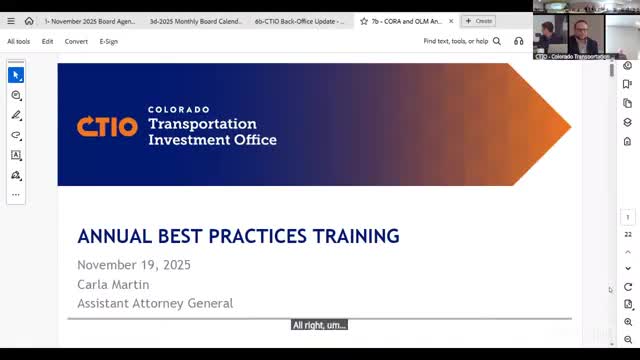
Summary
CTIO counsel Carla Marti provided required annual training on statutory powers, conflicts of interest, CORA and the Open Meetings Law, emphasizing that emails and internal communications can be public records and that executive sessions have narrow, specific purposes.
CTIO counsel delivered the agency’s required annual training on open‑records and open‑meetings obligations, reviewing statutory powers, conflicts of interest, and ballot‑case guidance the board should consider to avoid inadvertent waiver of privileges.
Carla Marti reminded the board that CORA (the Colorado Open Records Act) extends to emails and internal communications that concern public business, and that CTIO uses CDOT’s records custodian for requests. She reviewed notice requirements for meetings and described executive‑session rules, including the need to record executive sessions and the limited statutory reasons that permit them.
Marti reviewed conflict‑of‑interest obligations, noting board members cannot receive compensation beyond a per‑diem and must make written disclosures and on‑record disclosures when a matter would result in a direct economic benefit to them. She summarized two court examples—O'Connell and Sentinel, Colorado—showing how inadequate notice and improper executive‑session handling can create OML violations and how a board may or may not be able to cure those violations.
The counsel concluded with three takeaways: provide fair notice of meeting agendas; do not take formal action during executive sessions; and protect attorney‑client privilege to avoid inadvertent waiver. Board members asked clarifying questions and counsel offered to field follow‑ups.