Get Full Government Meeting Transcripts, Videos, & Alerts Forever!
Get email alerts on the Historic Preservation Materials topic
No spam. Unsubscribe anytime.
Geneva preservation staff demonstrates porosity tests, advises breathable mortars and finishes
Summary
At its November 2025 meeting, Geneva City's Historic Preservation Commission heard a '5-minute field guide' demonstration on porosity and permeability of masonry, and staff recommended lime-based mortars and breathable finishes over latex to reduce spalling and moisture damage.
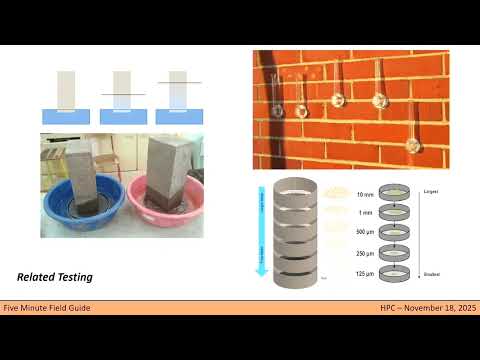
At its November 2025 meeting, the Geneva City Historic Preservation Commission heard a demonstration on the porosity and permeability of building materials and how those properties affect historic masonry. A preservation staff member demonstrated capillary-rise tests on two bricks — a hand-molded New Orleans brick dated about 1830 and a local, machine-pressed brick dated about 1915 — to show how water moves through masonry.
The presentation explained the difference between porosity (the amount of air space in a material) and permeability (how connected those pores are to allow liquid or gas to pass). "Porosity is the amount of air space in an object," Lisa, a city preservation staff member, said during the demonstration. She showed that the older New Orleans brick absorbed several inches of water in the bin test while the more modern brick absorbed much less.
Lisa advised using lime-based mortars on historic masonry rather than Portland cement mixes, saying lime mortar is softer and more permeable so it will "take that water" and help protect bricks from spalling. "If you put in a Portland cement or something like that that's not as porous and permeable, it gets stuck in the bricks and then the bricks start having those spalling issues," she said. She also discussed finish options: limewash and linseed oil are more breathable and allow moisture to move in and out, while modern latex paint can form a vapor barrier that traps moisture and accelerates damage.
The presenter described common diagnostic and testing approaches — absorption tests, Rylome testing, and sieve analysis for mortar — and emphasized that mortars and finishes are sacrificial elements that require periodic maintenance to protect more expensive structural materials. She pointed attendees to the National Center for Preservation Technology and Training (NCPTT) materials, MPS preservation briefs and an illustrated preservation brief available for further guidance.
Commissioners asked about practical details such as selecting appropriate mortar and whether limewash is available in colors; the presenter confirmed limewash color options and discussed linseed oil as a stain-like finish that can be refreshed with reapplication. The demonstration was presented as an educational item, with staff offering resources for property owners and professionals.
The commission did not take formal action on the presentation; staff provided handouts and indicated resources would be available for members and property owners.