Get Full Government Meeting Transcripts, Videos, & Alerts Forever!
Get email alerts on the Data Centers topic
No spam. Unsubscribe anytime.
Committee reopens data‑center exemption discussion, industry offers jobs and revenue estimates and supports reporting that mirrors other states
Summary
After hearing industry, utility and local officials, the committee pressed for better reporting on data‑center exemptions and impacts. Witnesses described what items are exempt, what is not, and offered to provide economic and jobs data; utilities said large‑customer contracts are structured to protect ratepayers.
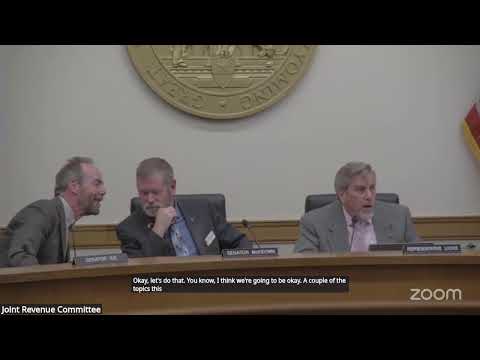
The Revenue Committee held an extended information session on sales‑and‑use tax exemptions for data centers and the absence of reliable public data about the exemptions' fiscal impact.
Josh Dorel, CEO of the Wyoming Business Council, explained the certification pathway: a data center applies to the Council, receives a certification letter and files with the Department of Revenue to claim the exemption. He described two historical tiers tied to investment levels (the statute uses a tier that referenced $5 million and $50 million thresholds) and said Tier 1 exempted computer equipment, servers and software while Tier 2 exemption coverage also included uninterruptible power supplies, backup generation, specialized HVAC and air‑quality control equipment. "You could think of... the guts of the data center" as the primary sales‑tax‑exempt items, Dorel said. He emphasized that electricity and property taxes are not exempt under the current incentive.
Industry testimony included Dan DiOrio of the Data Center Coalition, who offered an economic snapshot based on a PwC study commissioned by the coalition showing the sector supported nearly 4,000 total jobs (direct, indirect and induced) in 2023 and generated tens of millions in state and local tax revenues; DiOrio offered to share the PwC analysis with the committee. Local municipal data presented by Betsy Hale and the University of Wyoming Center for Business and Economic Analysis showed direct local data‑center employment of several hundred jobs and locally produced state and county tax receipts in recent years.
Utilities and ratepayer protections were raised by Black Hills Energy (David Bush), who said large‑customer contracts and tariff structures (large power contract service tariffs) require that large customers pay for incremental infrastructure and that the Public Service Commission signs off to prevent costs being passed to other ratepayers. He provided examples of transmission credits and noted that large loads also can stabilize utility revenue.
Committee members focused on the lack of consistent reporting. Representative Storer and others recalled that a statutory reporting requirement had been repealed in 2024 (House Bill 197) after low response rates on previous surveys. Committee members asked the Department and industry to craft a reporting approach that provides meaningful, aggregated data without unduly burdening businesses; industry witnesses indicated willingness to work on reporting metrics used in other states.
What happens next: Committee requested additional, itemized information from the Department of Revenue, the Business Council, local governments and industry (including PwC analysis) to quantify revenue foregone and jobs created and to craft any mandatory reporting that would align with other states' practices.
Key points: Data‑center sales‑tax exemptions historically have been limited to certain equipment; electricity and property taxes are generally not exempt under the current framework; industry and local governments will provide more detailed data to help the committee evaluate reporting options and fiscal impacts.