
Norwalk Parking Authority authorizes consultant to design residential parking permit program
Get AI-powered insights, summaries, and transcripts
Sign Up Free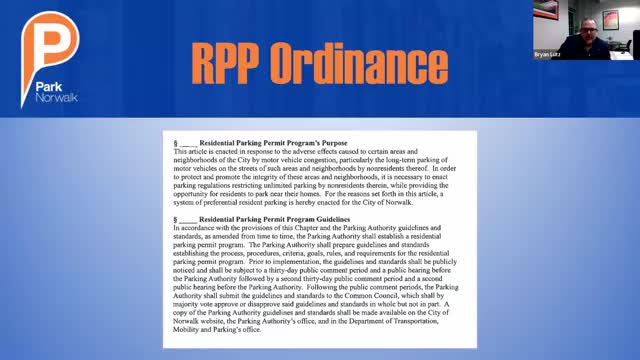
Summary
Following a Common Council ordinance passed Oct. 28, 2025, the Norwalk Parking Authority authorized staff to solicit proposals and retain a third‑party consultant (estimated $45,000–$65,000 from operator reserve) to develop guidelines, public‑hearing materials and implementation options for a citywide residential parking permit program.
The Norwalk Parking Authority voted unanimously to authorize city staff to pursue a consultant to develop a residential parking permit (RPP) program after the Common Council passed an ordinance on Oct. 28, 2025 establishing the program's purpose and procedural requirements. Brian, speaking for staff, read portions of the ordinance and told the board the authority must develop detailed guidelines and standards before implementing the program.
Staff said the ordinance requires two separate 30‑day public comment periods and two public hearings before the authority, followed by submission of the complete guidelines to the Common Council for an up‑or‑down vote. “Following the public comment period, the parking authority shall submit the guidelines and standards to the common council, which shall, by a majority vote, approve or disprove said guidelines and standards in whole, but not in part,” Brian read into the record.
To prepare a defensible, data‑driven program that can withstand scrutiny in multiple neighborhoods, staff recommended hiring an independent consultant to benchmark best practices, help develop eligibility criteria, model pricing and permit caps, design an implementation roadmap and assist with community engagement. Staff estimated consultant fees between $45,000 and $65,000 and said the cost can be covered from the authority’s existing operator reserve without changing parking rates or requiring city supplementation.
Commissioners emphasized the need for robust field work and broad community outreach. Commissioner Matthew Sebeck said the effort requires on‑the‑ground data collection and a clear public engagement plan before the authority brings recommendations back to the Common Council. Several commissioners suggested forming a subcommittee to review consultant proposals and oversee community engagement; staff agreed to solicit references and present recommended firms and scopes at a future meeting.
The motion authorizing staff to solicit proposals and engage a qualified consulting firm carried by unanimous voice vote. Staff said it will return with consultant proposals, a recommended selection process and a proposed public‑engagement timeline so the authority can meet the ordinance's public‑comment and hearing requirements.
Next steps: staff will solicit proposals, recommend finalists and propose a subcommittee to work through public‑engagement plans; the authority will host the required public hearings and then submit final guidelines to the Common Council for an up‑or‑down vote.