
Granite School District board votes to suspend Area 5 boundary study after lengthy public hearing
Get AI-powered insights, summaries, and transcripts
Subscribe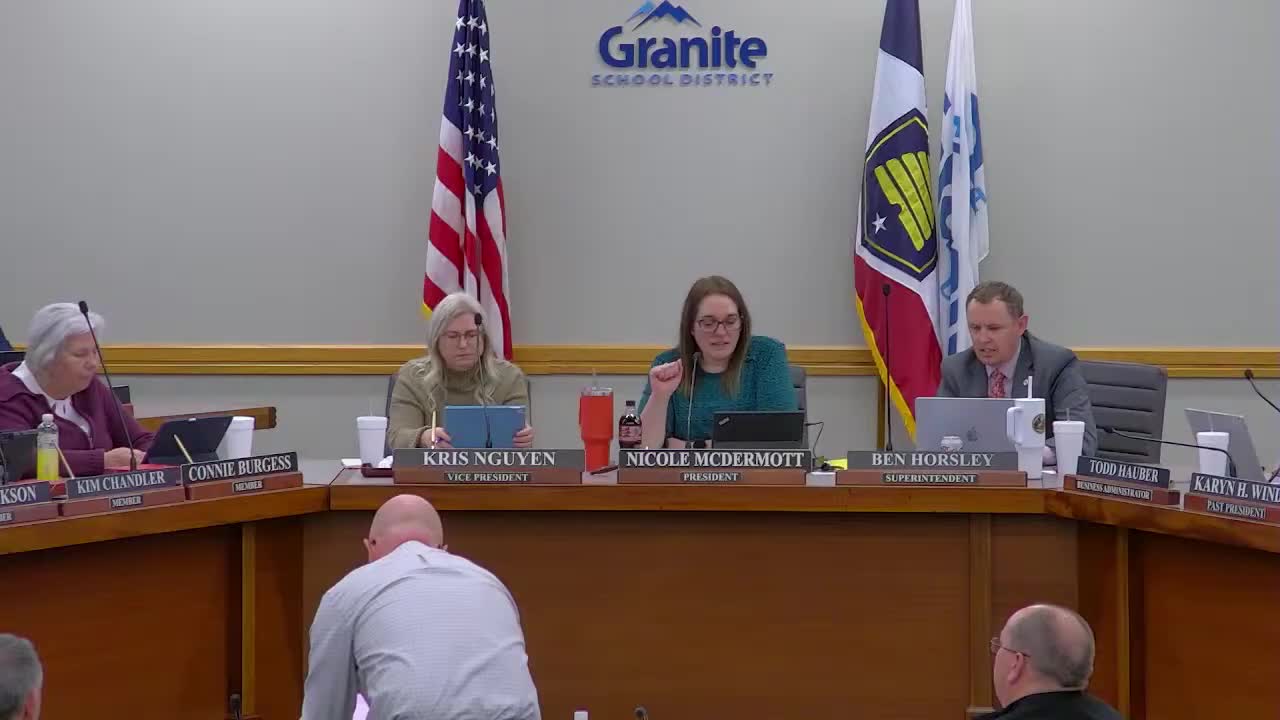
Summary
After more than 40 public commenters and extended discussion about data, process and community impacts, the Granite School District board voted Nov. 18 to suspend the Area 5 Population Analysis Committee boundary/closure study indefinitely and consider a larger, independent review when funding allows.
The Granite School District Board of Education voted Nov. 18 to suspend the Area 5 Population Analysis Committee (PAC) boundary and school-closure study indefinitely after hours of presentations, superintendent alternatives and public comment. The decision followed an extended hearing in which dozens of parents, teachers, students and community members urged the board to pause the process that placed Eastwood and Morningside elementary schools at risk of closure or merger.
Superintendent Ben Horsley presented the board with three options the district had prepared at trustees’ request: accept the PAC recommendation (which included merging Eastwood with Oak Ridge and closing the traditional program at Morningside), extend the study with an independent consultant through 2026 at an estimated cost the superintendent put between $500,000 and $1,000,000, or suspend the study indefinitely. Horsley told trustees that Area 5 presented unique complications — unusually high out‑of‑boundary permit rates, program interactions (ALC and DLI), and recent demographic shifts — that warranted reconsideration of the PAC recommendation.
The board then opened a public hearing under state law. The district recorded 41 people signed up to speak. Speakers from the Eastwood Community Advocacy Group and other neighborhood coalitions recounted school traditions, student‑teacher programs and local partnerships they said would be lost by closure. ‘‘If there is a closure or merge of Eastwood, we’re going to lose the network of teachers and their dedication to STEM,’’ said Kimberly Evison, a scientist and Eastwood parent, urging trustees to choose suspension.
Parents and students highlighted outcomes and assets at affected schools: Eastwood’s Gold STEM designation, kindergarten‑buddy programs, community volunteer efforts and local fundraising for labs and equipment. Several speakers also raised safety or logistical concerns about proposed bussing or courtesy stops, and multiple commenters urged the board to pursue alternatives that would allow the community to grow enrollment rather than close schools.
Other commenters pressed process and legal questions. One speaker, Naomi Keeson, cited provisions of Utah code that require particular motions and notice when initiating closure procedures and said she could not find motions that precisely met the code’s requirements in the board’s minutes. The district did not take a separate roll‑call vote listing individual tallies; after board discussion a trustee moved to ‘‘suspend this study indefinitely,’’ it was seconded, and the motion carried by voice vote.
Trustees framed the vote as a pause rather than abandonment. Several members said the district still faces a structural enrollment decline driven by birth‑rate changes and competition from charter and online programs and that a more comprehensive or district‑wide independent study — including capital and facilities planning — may be needed when funding allows. Horsley noted the district’s budget pressures, citing an estimated $14 million shortfall over the next two years tied to state funding changes.
The board also discussed the practical tradeoffs of an outside consultant: the superintendent said a truly district‑wide, independent evaluation could cost in the high hundreds of thousands or more but could yield a fuller recommendation; some trustees emphasized urgency to avoid leaving schools with prolonged unstable class sizes.
Next steps: the board said it expects to work with parents, community councils and district staff to channel community energy toward enrollment and program strategies and to consider the scope and funding of any future independent study. For now, the PAC’s Area 5 recommendation will not proceed to closure votes.
Quotes used in this article come from speakers recorded in the public hearing and from superintendent remarks made during the Nov. 18 meeting.