
District outlines AI literacy pilots and student-facing safeguards; directors ask for clearer goals and independent expertise
Get AI-powered insights, summaries, and transcripts
Sign Up Free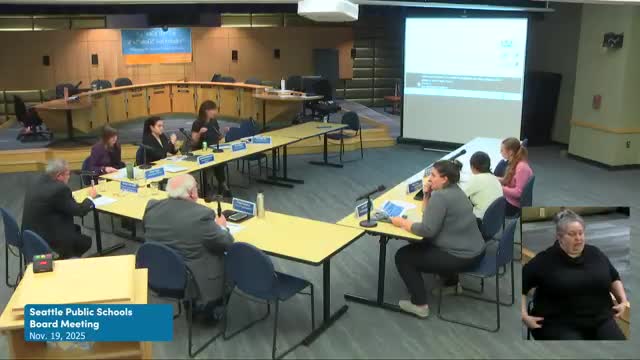
Summary
Seattle Public Schools presented classroom AI pilots (Magic Student/Magic School), teacher training and vendor controls; board members praised literacy work but pressed for clearer metrics, stronger teacher support and independent research to avoid undue vendor influence.
Seattle Public Schools briefed the board Tuesday on its artificial intelligence work: a technology steering committee recommended district AI literacy lessons, teacher training and carefully scoped classroom pilots that give teachers control over student access.
Assistant Superintendent Mike Storozki said the district’s approach centers on human-guided, developmentally appropriate use. The district piloted generative-AI tools in seven schools representing 36% of its grades 6–12 enrollment, testing teacher-managed “Magic Student” classroom rooms and educator tools such as Microsoft Copilot for staff use. Staff said elementary students are not being given access to the district’s generative-AI classroom tools.
Storozki described a theory of action: train educators in AI literacy, provide approved, safety-reviewed tools and then allow teachers to integrate tools intentionally into lessons. The steering committee also produced K–12 lessons on AI basics, bias, ethics, algorithmic impacts and media-literacy considerations.
On privacy and security, district IT staff said they block public large language models (ChatGPT and Gemini) from district devices, vet vendors through a software-intake and legal-review process, enforce data-sharing agreements, run monthly vulnerability scans and maintain redundant data centers and recovery plans. Staff said selected classroom tools keep data within district-controlled systems where possible.
Directors raised concerns about cheating, intellectual-property and environmental impacts of large models; several directors recommended independent research and external expert review to avoid accepting vendor claims at face value. Vice President Briggs explicitly warned of undue industry influence and urged staff to seek guidance beyond companies marketing products. Teachers’ workload was another theme: directors asked how the district would help teachers integrate AI responsibly without making them the only gatekeepers.
Staff said the steering committee will post lessons and resources online, continue educator professional development and refine recommendations based on additional engagement and piloting. Directors asked for concrete success metrics — e.g., measures of student learning gains, changes in teacher workload or reductions in academic dishonesty — tied to the district’s goals before broad rollout.
Board members acknowledged the potential classroom benefits — personalized study support, drafting aids and differentiated feedback — but asked for guardrails and explicit privacy reviews before scaling.