
Board hears proposal to standardize student phone rules; directors press for clearer enforcement and equity
Get AI-powered insights, summaries, and transcripts
Sign Up Free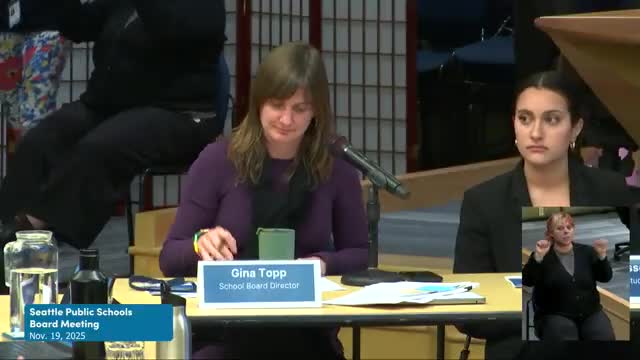
Summary
District staff proposed a tiered approach to student cell-phone use — elementary bans, middle-school ‘away for the day,’ and limited high-school access — prompting board questions about enforcement, accommodations for students with health or safety needs, and clearer success metrics.
District staff presented a recommended update to the superintendent procedures governing personal devices, saying their engagement with five schools and surveys of principals and students support a differentiated approach.
Carlos Del Valle, the district’s technology official, summarized a citywide study involving Hamilton Middle School, Robert Eagle Staff, Ballard, Rainier and others. Staff reported benefits observed in some schools after tighter phone limits — improved instructional time, increased student focus and fewer reported online incidents — and said application of rules varies widely across schools. As a result, the proposed guidance would standardize expectations while leaving implementation details to schools.
The emerging approach presented to the board would prohibit phone access in elementary schools; require middle schools to keep phones “away for the day” (including passing periods and lunch); and limit high-school phone use to away-during-class with teacher permission for specific instructional activities.
Board members pressed staff on enforcement and consistency. Vice President Briggs and Director Rankin argued that teacher discretion can reintroduce the same inconsistency the district wants to avoid; they and other directors discussed pouch systems, schoolwide enforcement, and how zero-tolerance models affect teachers’ workload. Several directors asked staff to clarify what “away for the day” means (backpacks/lockers vs. staying off campus) and whether district-provided pouches or other tools would be required.
Directors also raised equity and safety issues: some families give younger students phones for safety during commutes, and students with medical accommodations (for example, diabetes monitors linked to phones) need explicit carve-outs. Staff said accommodations will be addressed in the superintendent procedure and that the district will validate pilot findings with further family engagement before recommending implementation next school year.
Several directors requested clearer metrics to evaluate the policy’s effects — for example, measuring instructional minutes regained, changes in behavioral incidents or survey-based climate measures — and urged staff to partner with researchers or universities where possible. Staff said they will continue engagement with families, principals and student leaders and refine the procedure for a December recommendation to the superintendent ahead of implementation planning for 2026–27.