
Baldwin Park honored with Helen Putnam award for tiny‑home homeless initiative
Get AI-powered insights, summaries, and transcripts
Sign Up Free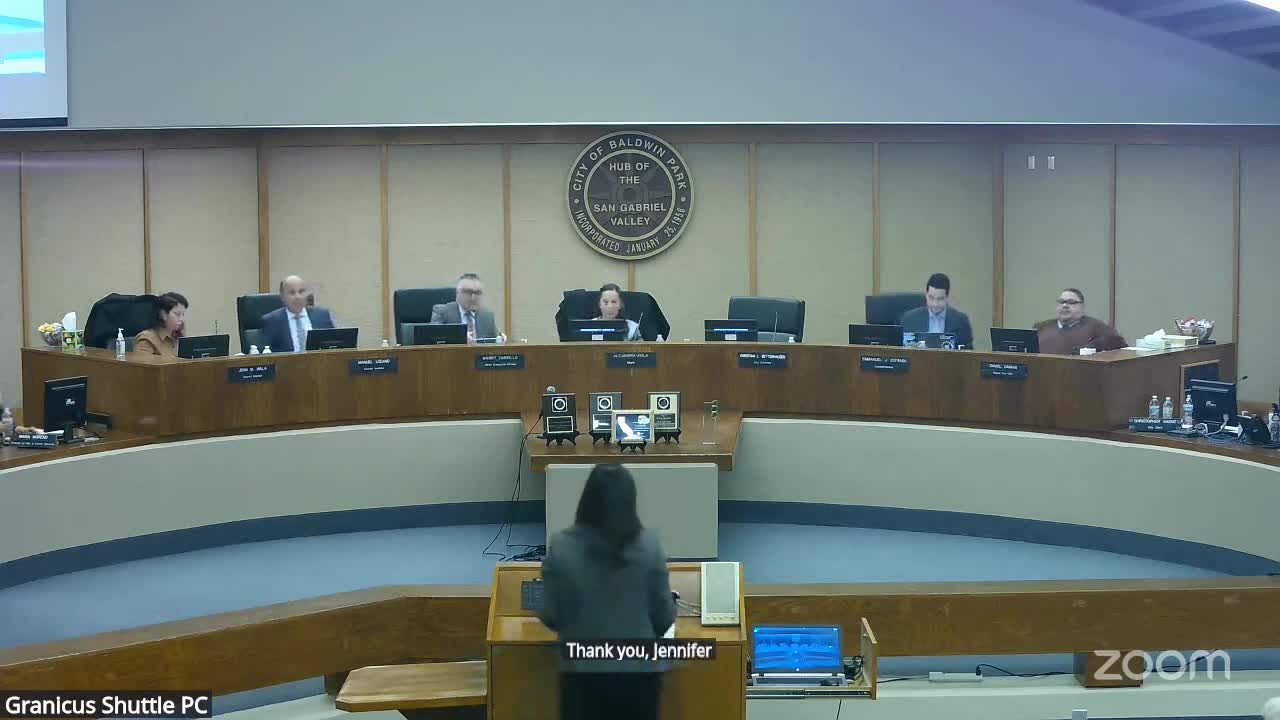
Summary
The League of California Cities presented Baldwin Park with the Helen Putnam Award for its twin tiny‑home projects—Esperanza Villa and Serenity Homes—which the city says helped drive an 80% drop in homelessness over five years.
Jennifer Kwan of the League of California Cities presented the Helen Putnam Award to the City of Baldwin Park on Nov. 19, honoring the city's homelessness reduction initiative built around two tiny‑home facilities, Esperanza Villa and Serenity Homes.
The award citation called the effort "an innovative and transformative" model that pairs noncongregate shelter for individuals with a family‑focused bridge housing project. "City of Baldwin Park received the Helen Putnam award for their homeless reduction initiative featuring 2 tiny home facilities, Esperanza Villa and Serenity Homes," Kwan said during the council meeting.
Mayor Alejandra Avila, who accepted the honor, outlined how the program operates and thanked a long list of city departments, nonprofit partners and funders. She credited two dedicated police liaisons, Officer Izzo and Officer Barrios, a robust intake process led by Armando Nava in Parks and Recreation, and housing staff who help participants obtain vouchers and transition to permanent housing. "We have gotten individuals off the street because of the outreach these police officers do," Avila said.
Council Member Emmanuel Estrada and Mayor Pro Tem Damien also praised the approach, noting strong community engagement and cross‑agency cooperation. The city highlighted outcome figures during the presentation: an 80% reduction in homelessness over five years, 106 families transitioned to permanent housing, and Esperanza Villa serving 25 individuals annually with family stays at Serenity Homes averaging three to six months.
City officials listed many partners and funding sources that supported the projects, including the San Gabriel Valley Regional Housing Trust, San Gabriel Valley Council of Governments, Los Angeles Homeless Services Authority, Los Angeles County, state housing agencies, Supervisor Hilda Solis' office, Senator Susan Rubio's office, Habitat for Humanity, IKEA, Kaiser Permanente and others. The mayor also cited recent county contributions described during the meeting (discussion referenced $1.2 million in support over two years and a recent check noted during remarks).
The council framed the award as recognition of a coordinated, multi‑departmental strategy that emphasizes outreach, case management and partnerships. The presentation concluded with a photo of staff and partners and public acknowledgment of volunteers and contractors who helped build and operate the tiny‑home communities.
The council moved on to regular business after the recognition; no formal action on the award itself was required.