Safety report: Volusia highlights threat-reduction data and green-lighted pilot for new technologies, including drones
Loading...
Summary
Captain Todd Smith reported quarterly data under House Bill 1473 showing reductions in several threat-related measures and announced Volusia County Schools was selected for the state Campus Guardian Angel pilot; Smith also described a drone pilot integrated with the panic-alert system and drew board questions about policy and logistics.
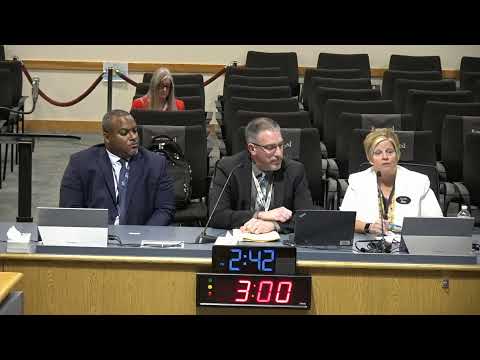
Captain Todd Smith, director of safety and security, presented the quarterly safety report required under House Bill 1473 and described the district's layered approach to school safety.
Smith said no schools were inspected or reinspected by the Office of Safe Schools in the first quarter ("0 schools were inspected or reinspected"), and he reported no school safety requirement deficiencies for that quarter. He told the board metal detectors were fully implemented at six high schools: Pine Ridge, Atlantic, New Smyrna Beach High, Seabreeze, Pearson and Mainland, and that full implementation districtwide remains delayed by vendor production issues.
Smith described training and operational work: monthly reunification-team drills, training for principals, assistant principals and deans, threat-management training and adoption of best practices from the Police Executive Research Forum and the U.S. Secret Service. He said the district created a behavioral threat unit after reviewing recommended models and visiting other Florida districts.
On comparative metrics, Smith told the board the district saw reductions from last year in several areas: a reported 50% reduction in arrests for written threats to kill (from 20 to 10 in week 9), a 72% decline in Florida Tips (494 to 136), and a reduction in recovered weapons (13 last year at nine weeks compared with four this year). Smith said the district historically averages about two firearms discovered per year on campuses and reported no firearms discovered so far this school year.
Smith announced the district had been named one of three counties awarded the state Campus Guardian Angel pilot program and described it as "another layer" in the district's safety plan.
He also outlined a proposed drone pilot as a rapid-response tool: "The drones are stored on the campus in different locations...goal is to launch within 5 seconds...they can get across the campus in 8 seconds," Smith said. He described drones equipped with flashing lights, sirens, a microphone and a pepper gun intended to distract or disorient a threat; he added the system would be integrated with the Syntegix panic alert so a lockdown activation could trigger deployment. Board members asked for more policy details and raised questions about logistics, privacy and how the drone would operate if a threat were inside a room. Smith said the pilot has been green-lighted but that procedures and policies still must be developed.
Board members congratulated the safety team on the reported reductions and asked staff to return with more details about the drone pilot, Campus Guardian Angel integration and comparative national-versus-local statistics.
Next steps: staff will develop policy recommendations and operational procedures for any drone pilot and provide the board with further data and detail on pilot integration with the district's reunification and alert systems.