Get Full Government Meeting Transcripts, Videos, & Alerts Forever!
Get email alerts on the County Budget topic
No spam. Unsubscribe anytime.
Spokane County reviews budget shifts, adds one‑year juvenile funding and $20,000 for children’s waiting room while holding sales‑tax projection at about 2.2%
Summary
Spokane County commissioners reviewed budget adjustments after an executive session, agreed to add two juvenile positions on a roughly one‑year basis (about $165,000), approved a $20,000 children’s waiting‑room line, discussed a one‑time ~$93,000 share for DEM and used a 2.2% sales‑tax projection to balance the draft budget.
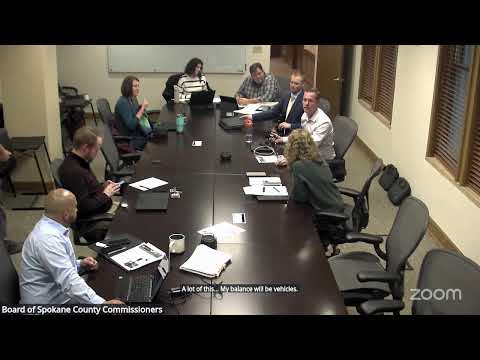
Spokane County commissioners continued a budget workshop after a brief executive session and agreed to several targeted, mostly one‑time funding moves while using a roughly 2.2% sales‑tax projection for next year.
The board was told a recent state assessment added about $99,000 to the county’s revenue picture, which staff said provided a small increase in capacity for balancing. Staff framed detention services as a priority and presented two service packages that included embedded case managers and education programming; commissioners discussed the gross expense figures and the fact that revenue offsets are reflected elsewhere in staff materials.
Commissioners agreed to include two juvenile positions tied to a pilot program — described by staff as embedded case management — estimated at about $165,000 for the positions combined. Tory, identified in the meeting as director of juvenile services, was invited to return with data from the pilot so the board can review outcomes before making longer‑term commitments.
The board also placed a $20,000 one‑time line item for a children’s waiting room on the budget worksheet after a presentation from Vanessa Behan. Staff said the waiting‑room request was added for final decision pending confirmation.
On emergency management (DEM) staffing, commissioners discussed a one‑time fund‑balance contribution in the $90,000–$100,000 range (the staff estimate and math repeatedly cited yielded about $93,000 for the county’s share). Several commissioners emphasized that funding this as a one‑year bridge would buy time to seek commitments from other jurisdictions but warned those partners have not yet provided funds.
Parks staffing remained under review: two park FTEs are currently funded in REIT and staff noted those positions were left in REIT rather than moving them into the general fund in this iteration of the budget. Staff also referenced a $100,000 eDiscovery item for public‑records support that is included in the materials.
On revenues, staff and commissioners worked through sales‑tax math and agreed on a working projection of about 2.2% for the coming year, noting preliminary year‑to‑date figures remain higher than the 2% baseline used in earlier drafts. Officials said that projection, together with the modest extra assessment revenue, would allow the one‑year funding moves without a permanent tax increase.
Aboard the items for follow‑up, a board member proposed directing communications staff to send a notice about the decision not to increase taxes. "I think we should direct Pat to send out a press release," one participant said during the meeting; the board signaled assent and asked staff to distribute the message.
The meeting included no recorded formal vote on ordinance or tax‑rate adoption during the session. Staff said they would enter the one‑year funding items into the system and return with additional details — including the juvenile pilot data and any further updates on interjurisdictional DEM contributions — as the budget process continues.
The board returned from an earlier executive session with the chair noting, "No decisions have been made," underscoring that the executive session produced no public action during this portion of the meeting.