
CDOT outlines 10-year plan for Western Slope: safety, paving and transit projects top list
Get AI-powered insights, summaries, and transcripts
Sign Up Free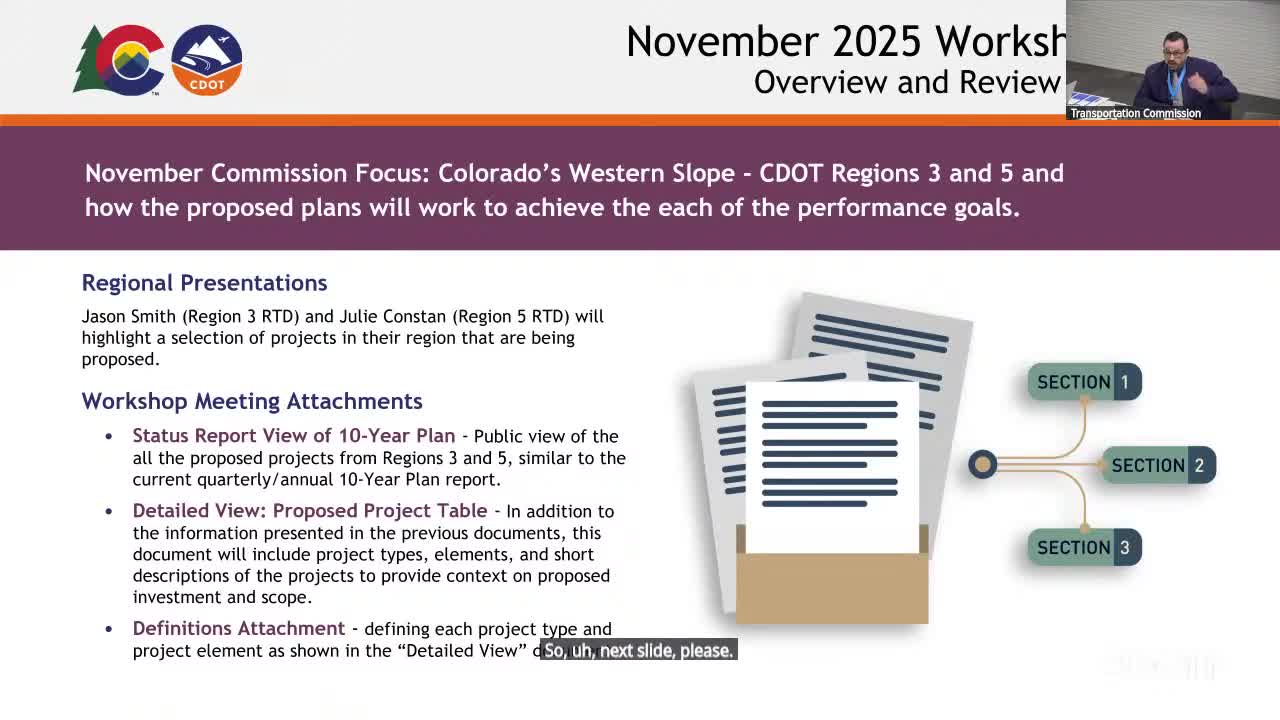
Summary
CDOT staff presented a draft 10-year plan for fiscal years 2027'36 focused on Regions 3 and 5, identifying 81 projects on the Western Slope including major safety upgrades, rural resurfacing and new transit operating support. Commissioners pressed for definitions, trade-offs and funding sources ahead of a public comment period.
Colorado Department of Transportation staff on Friday presented the Transportation Commission with a draft 10-year plan for fiscal years 2027 through 2036 focused on the Western Slope, saying the package would fund safety upgrades, pavement preservation and expanded transit options in Regions 3 and 5.
Jason Smith, Region 3 transportation director, told the commission Region 3 carries roughly 45 projects in the draft plan and that his region has about $132,000,000 of proposed strategic funding in the first four years and $198,000,000 for the remaining six. "We have about 45 projects total, for the next 10 years," Smith said, and highlighted safety-focused work including a phase 2 safety project on US 40 (Red Dirt Hill) and I‑70 interchange improvements in Garfield County.
Julie Constant, Region 5 director, said Region 5 will carry 36 projects into the plan, eight of them new, with about $69,000,000 planned for FY27'30 and $103,000,000 for later years. She highlighted a roughly 4-mile, $100,000,000 reconstruction of Highway 160 — including a center turn lane, four-lane widening in places and a roundabout at a county road — that received about $59,000,000 in an INFRA grant.
Commissioners pressed staff on several technical and programmatic details. Commissioner Mark McLaughlin asked for clarification about cold-in-place recycling for Colorado 149; Jason Smith explained why a cold process was chosen after a high-elevation hot-in-place project failed to achieve required density and allowed moisture to penetrate the pavement. Commissioners also asked how CDOT classifies projects that have multiple aims — safety, asset management, and multimodal choice — and how a proposed passing-lane program will be defined. Staff said passing lanes will generally be kept to about one mile and that a continuous segment longer than two miles is typically treated as a capacity expansion.
Darius Pacwas, a CDOT planning lead, said the packet contains full lists of projects and definitions and that the department will continue work with planning partners, STAC and regional transportation planning organizations before returning to the commission. He also outlined a timetable for next steps: a January workshop on Front Range regions, a public comment period following the January presentation and a possible adoption vote at a future commission meeting.
The commission did not take a final vote on the plan during the workshop. Staff said the department will bring additional detail — including project descriptions and financing options — ahead of the public comment period.