
New Haven committee approves multiyear contract to launch automated traffic enforcement program
Get AI-powered insights, summaries, and transcripts
Subscribe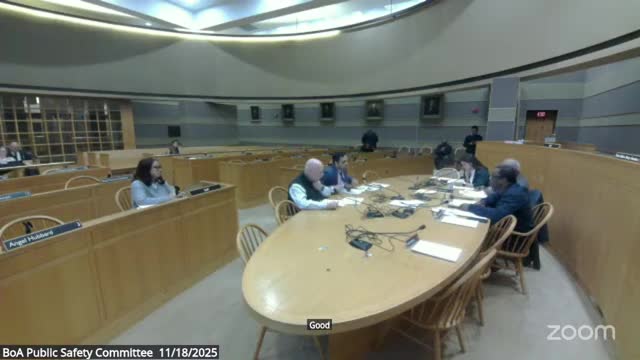
Summary
The Public Safety Committee approved a multiyear agreement enabling automated traffic enforcement devices (ATESD) after staff outlined state approvals, vendor selection (Nova Global), a 30-day warning period, and back-office fees; members pressed staff on rental vs. purchase costs, plate-read reliability and enforcement rules.
The New Haven Public Safety Committee on Nov. 18 approved a multiyear contract that clears the way for automated traffic enforcement devices citywide, staff said. The agreement would let the city install red‑light and speed cameras through a vendor contract recommended after state plan approvals.
Transportation Director Suneef told the committee the city began the ATESD process in October 2023, received board approval in April 2024 and secured state approval in October after technical reviews. "Automated traffic enforcement will be a big complement of that as we roll into early next year," the director said, describing the program as one tool in a broader Vision Zero‑style safety plan.
Staff said they submitted 19 candidate locations using a rubric based on crashes, traffic volumes, land use and equity. The state approved a smaller set of sites; staff noted a map showing 15 approved dots and described state approval of multiple red‑light locations and a subset of proposed speed‑camera sites. Staff emphasized that selected signals were recently upgraded and would be retimed where needed before enforcement.
On enforcement rules, staff confirmed the statute requires a 30‑day warning period and clear signage before citations begin. "The statute does require to have a warning period ... 30 day warning period," the director said. Staff also outlined the adjudication process: vendor teams and an internal adjudicating officer review frames and determine whether a recorded event constitutes a violation; hearing officers remain available for residents who wish to contest citations.
Members pressed staff on the program's finances. The contract is structured around monthly camera rentals rather than outright camera purchases, staff said, because the full system includes software, back‑office processing, mailing costs and staffing that vendors also supply. Deputy Director Eric Hoffman said rental allows vendors to cover high upfront installation costs, typically $40,000–$50,000 per camera at complex intersections, and reduces the city's lifecycle and obsolescence liability. He added the contract includes maintenance and annual calibration and the city will have an on‑staff technician to monitor field operations.
Hoffman explained the payment model: a $50 civil violation is imposed under the city's ordinance, and a $4 citation processing fee in the current draft goes to the vendor to cover mailing and portal services; the city ordinance allows an additional fee of up to $15 consistent with state law. "The $4 is actually going to the vendor," Hoffman said. Staff also said negotiated terms reduced typical industry shares; many vendor models take a 30–40% cut of fines, but the procurement yielded a lower effective share.
Public commenters who addressed the committee supported the program as a safety tool. Abigail Roth, who gave her address as 42 Lincoln Street, said she attended a remembrance for victims of traffic violence and cited statewide fatalities: "over 250 people were killed in the past year in Connecticut on our roads," she said, urging timely implementation.
Committee members also asked about common operational problems, including malfunctioning signals and obscured or altered license plates. Staff acknowledged these "leakage" issues and said vendors use flash and image‑processing tools to improve plate reads; the statute also requires reporting to the state on citations issued and citations not issued because of problems such as unreadable plates.
Before the vote, several members spoke in support of using enforcement as part of a multi‑pronged safety approach; the committee called the question and recorded verbal "Aye" responses for approval. The committee also discussed the requirement to return periodic reports under state law and to use any net revenues for traffic‑safety investments as required by statute.
The committee's approval sends the contract to the next procedural step for finalization and execution by the mayor's office. Staff said implementation and the 30‑day warning period are expected to begin once contractual details are complete and any outstanding state steps are satisfied.