
Expert warns broad heat pump adoption could raise winter costs and stress grid resources
Get AI-powered insights, summaries, and transcripts
Subscribe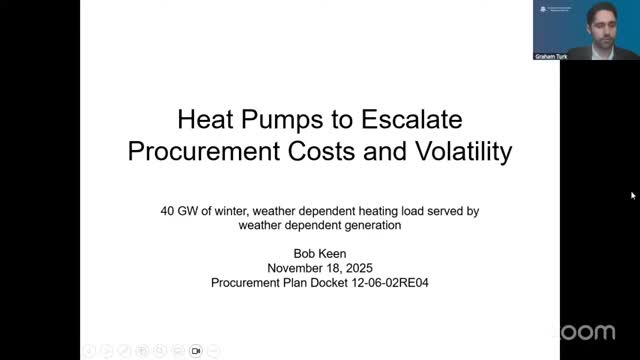
Summary
In PURA’s technical meeting, Bob Keane presented modeling showing heat pump adoption can sharply increase winter peak demand, capital needs and marginal costs; he recommended demand-side measures, separate residential load profiles, and caution on subsidies that could shift costs to non‑heat‑pump customers.
Bob Keane presented technical analysis warning that large-scale heat pump adoption could substantially increase New England’s winter peak and raise marginal generation costs. Keane described heat pumps as a low load factor, winter‑peaking addition whose marginal cost in some ISO studies rises much faster than load, citing an example where a 4.5% heat‑pump-driven load increase raised system costs by roughly 53% in a modeled year.
Keane said the load factor of heat pumps is low and that efficiency declines at low ambient temperatures, which can drive wintertime marginal generation bids to much higher levels. He argued that these outcomes mean heat pumps can increase both short‑term volatility and longer‑term capital needs for generation and storage unless demand-side pricing, optionality (batteries, curtailable loads), or different incentive targets are developed. Keane recommended targeted programs—prioritizing conversions from electric resistance heating, using advanced metering to reflect separate load shapes, and avoiding broad subsidies that add winter load without addressing system costs.
Stakeholders asked questions about whether the near‑term planning calculus changes depending on the pace of adoption and regional supply constraints. Keane replied that partial or hybrid approaches (e.g., backup fuels or partial electrification) and more-efficient boilers in some areas could be lower‑cost near‑term alternatives for certain customers. PURA did not adopt any policy changes at the meeting; Keane’s presentation was entered into the docket record for further consideration.