
Pleasanton reviews BART station TOD concepts that could add hundreds to over a thousand homes
Get AI-powered insights, summaries, and transcripts
Subscribe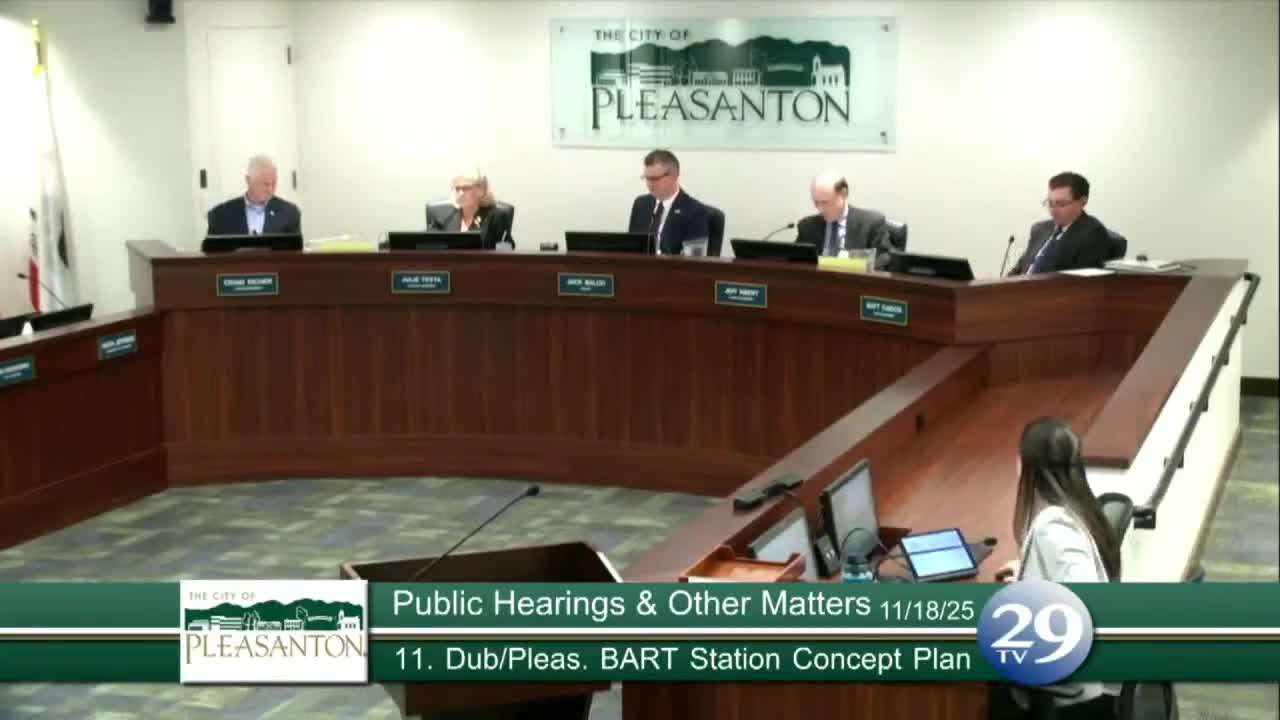
Summary
City staff and BART presented concept plans for the Pleasanton/Dublin BART station, including two test‑fit scenarios that would add roughly 870–1,300 housing units (with 20% minimum affordable under state TOD rules), new plaza and parking strategies; council gave informal support and asked staff to refine parking and access studies.
Pleasanton City Council members on Nov. 18 reviewed a concept plan developed with BART and consultant teams for transit‑oriented development (TOD) at the Pleasanton/Dublin BART station. The informational item did not require action, but council provided detailed feedback for staff to incorporate into a development framework and the upcoming parking/station‑access study.
BART’s TOD representative described the agency’s program and its regional role; consultants from Van Meter Williams Pollock presented two 'test‑fit' scenarios for the approximately 11.3‑acre site. Together the scenarios produced a holding‑capacity range of roughly 870 to 1,300 housing units, with state TOD law setting minimum standards — described in the presentation as a minimum five stories, a minimum of about 75 dwelling units per acre, and at least 20% affordable units. Design options included podium or wrap construction for concealed parking, a large public plaza tied to the Iron Horse Trail, and separated bike facilities on Owens Drive.
Key concerns from council and the public focused on replacement/management of BART rider parking (staff noted there are about 1,350 Pleasanton‑side spaces and roughly 3,650 total spaces in the station area), how phasing must maintain an agreed number of BART spaces during construction, potential funding sources for structured parking, and neighborhood compatibility regarding building height. Several council members favored the "test fit 1" approach (wrap/podium and a bulb/drop‑off) and a protected off‑street bike lane (option B2). Public speakers urged higher affordable‑housing yields, family‑friendly unit mixes, secure bike parking and short‑term parking/delivery access to support ground‑floor uses. Staff said they will carry council direction into the draft framework and the planned parking management and station access study, which will be used to inform any future RFP by BART.
Because BART is the landowner, BART will manage the RFP and developer selection process, but staff emphasized Pleasanton will collaborate closely on design, parking and access requirements. Staff also noted constraints including an existing fuel transmission pipeline that limits development in portions of the site and the need to secure grant or other funding if large structured parking is required. Council asked staff to return with integrated analysis and to incorporate public input around plaza use, access, and affordability targets as the plan advances.