Get Full Government Meeting Transcripts, Videos, & Alerts Forever!
Get email alerts on the Gaming Policy topic
No spam. Unsubscribe anytime.
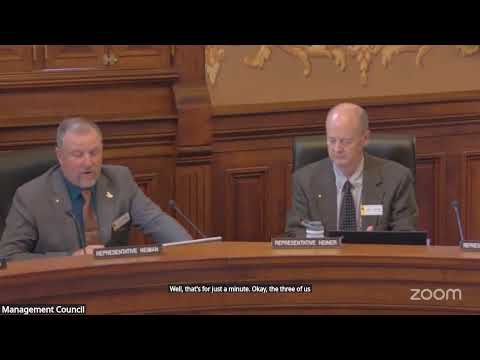
Management Council sponsors several gaming bill drafts after hours of debate
Summary
After extended testimony from industry and local officials, the Management Council voted to sponsor multiple gaming-related bill drafts for the 2026 session, including gambling-definition amendments and local simulcasting approval, while a proposal to cap historic-horse-racing terminals failed on a close vote.
The Management Council on Nov. 18 voted to sponsor a package of gaming-related bill drafts for the 2026 budget session after a lengthy presentation by the Select Committee on Gaming and sustained public testimony.
Senator Cole, co-chair of the select committee, told members the drafts address statutory ambiguities that have hampered enforcement and local control. He highlighted Draft 169, which tightens definitions such as "bona fide social relationship" and the definition of profit to make prosecutions of illegal gaming clearer, and said the package grew out of a task force's effort to respond to cases where terminals and skill-based games appeared in venues such as grocery stores.
Why it matters: law enforcement and prosecutors told the committee they need clearer statutory language to pursue organized or commercial gaming operations, while local officials and new industry entrants warned that changes could create unintended market consequences.
The committee voted to sponsor the gambling-amendment draft (management sponsorship for 26LSO0169) and the anti-money-laundering draft (26LSO0146). Affie Ellis, an attorney representing Cowboy Racing, urged retention of provisions that preserve the 100-mile geographic protection and due-process rights for applicants, saying those features were essential to invitations for private investment in live horse racing.
Industry and local-government testimony diverged on policy choices. Wyoming horse-racing operators and investors described multi‑million-dollar destination projects under construction and defended the connection between historic-horse-racing (HHR) terminals and funding for live racing purses. "The HHR machines provide the mechanism to fund purses," said Pete Liguori, part owner of Wyoming Horse Racing, noting that higher purses have attracted national-level trainers and increased related agricultural business.
Opponents and some members of the council pressed for limits. Representative Harrelson said she hears public concern that the machines have created the perception of casinos in towns: "They see kiosks that look like slot machines and they think it's a casino." Several members questioned whether a cap on permitted terminals (originally 1,200 in earlier drafts) should be preserved rather than the larger allowance discussed in committee.
Votes at a glance: The council approved management-sponsorship motions for Draft 169 (gambling amendments) and Draft 146 (anti-money-laundering). It also voted to sponsor Draft 145 (local approval for simulcasting), which clarifies municipal and county approval authority and limits the circumstances under which a locality may deny a permit. A separate motion to sponsor Draft 168 (limitations on HHR terminals) failed on a close vote (recorded tally: 4 Aye, 5 No, 1 excused).
What happens next: Sponsored drafts will appear on the Management Council's legislative packet for the 2026 budget session. Committee chairs and industry representatives said they expect continued negotiations on the numerical limits, grandfathering language, and how local permit renewals will be handled.
Quotes: "We need to do something to get our arms around it," Senator Cole said of the rapid expansion of gaming activity. Affie Ellis warned that removing the 100-mile rule or due-process provisions would undermine private investment in new tracks. "If they were to go away, our support for this bill would very much go away as well," she said.
The meeting recessed for a one-hour lunch and reconvened at 1:00 p.m. with remaining agenda items scheduled for the following day.