
Citrus County planners review Cardinal Street IMA and draft land‑development code updates amid debate over graywater, density and truck stops
Get AI-powered insights, summaries, and transcripts
Subscribe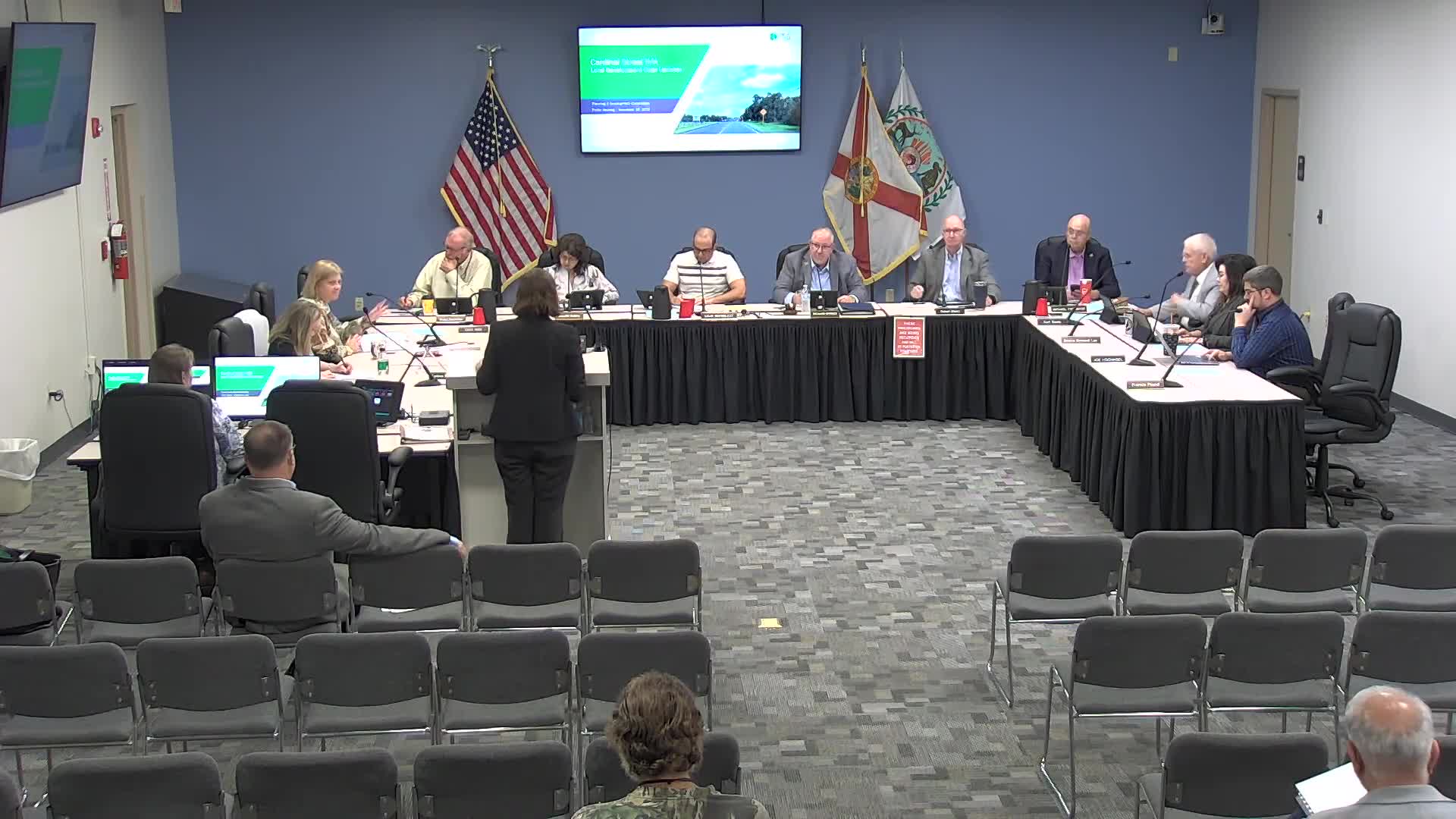
Summary
Consultants presented land‑development code amendments to implement the Cardinal Street interchange management area, proposing new EDTA and mixed‑use districts with minimum project sizes, density caps and a floor‑area ratio. Commissioners pressed for clearer graywater language, transportation analysis and limits on truck stops and standalone storage.
Consultants for Citrus County on Thursday presented a draft land‑development code (LDC) intended to implement the Cardinal Street interchange management area (IMA), a plan-area tied to the Suncoast Parkway extension, and invited commissioners to weigh in on density, infrastructure and permitted uses.
Amanda Warner, a planner and project manager for Wade Trim, traced the project’s history to a 2019 Tampa Bay Regional Planning Council focus‑growth scenario and subsequent county comprehensive‑plan amendments. She said Wade Trim worked with county staff and stakeholders beginning in 2022 to craft LDC language to reflect the 2024 comprehensive‑plan changes and now proposes a Cardinal Mixed‑Use District and accompanying use standards.
The draft sets numeric rules for two subareas: an Economic Development Target Area (EDTA) and a Mixed‑Use Area. Key proposed standards presented to the Planning and Development Commission include a nonresidential floor‑area ratio of 1 (upgradable with residential components); EDTA lot coverage of 70% (50% in the mixed‑use area); a 20% minimum open‑space requirement for residential uses; a mixed‑use minimum density of 6 dwelling units per acre, a baseline maximum of 12 du/acre and a density bonus up to 20 du/acre where projects provide integrated public amenities such as parks, schools or libraries. Warner also said new development would be required to provide or connect to central water and sewer and that graywater reuse would be encouraged.
Commissioners offered several directed critiques and asked staff to tighten the draft before it comes back as an ordinance. Multiple commissioners urged stronger language on graywater infrastructure — suggesting that projects be required to stub in “purple pipe” or other basic accommodations during initial construction so future connections are feasible and less costly. Warner and county staff responded that the current draft encourages graywater but stops short of a mandate because graywater availability is not yet countywide; staff said PUD review would evaluate feasibility and that the LDC could be revised to require connection if graywater becomes available.
Transportation capacity and implementation sequencing drew sustained attention. Several commissioners said Cardinal Lane and County Road 491 are narrow two‑lane roads that could be strained by future development tied to the parkway. Staff said the county’s multimodal transportation element is being updated and will examine level‑of‑service and possible road upgrades; however, transportation projects were not part of the LDC workshop itself.
Commissioners also probed how the IMA would be triggered on a parcel‑by‑parcel basis. Warner said the mechanism is designed so existing properties remain under their current land‑use designations unless an owner proposes activity that meets specified triggers — new nonresidential or mixed‑use development, expansions exceeding 25% of gross leasable area, or certain residential increases. Property owners with existing PUD entitlements would generally be vested unless they seek changes that cross the thresholds.
A recurring debate concerned permitted and prohibited uses. Staff’s draft allows intense industrial and logistics uses in the EDTA (for example, warehousing or vehicle operations) and prohibits new residential uses there; it also prohibits certain uses countywide in the mixed‑use area, such as mini‑storage and outdoor storage as standalone uses. Some commissioners and members of the public argued that well‑designed multistory storage can provide a buffer between heavy industrial operations and neighborhoods and that high‑density housing markets create a demand for storage. Others warned that truck stops, heavy repair operations and outdoor RV/boat storage would undermine community character; commissioners signaled they would ask staff to refine language on truck stops and to make outdoor storage explicitly ancillary to an existing industrial use rather than a permitted standalone use in the EDTA.
Public commenter Joe Capicelli urged the county to reconsider multistory storage and to evaluate applying consistent standards on both sides of County Road 491 so similar parcels are regulated the same way.
Warner said the draft also includes visual‑clarity tools — plan graphics and a separate user guide of architectural illustrations and implementation steps, similar to materials used for other IMAs — and staff agreed to add a reference to that guide in the LDC. She said the draft will be revised based on commissioner feedback and returned for workshop and ordinance consideration; if the PDC approves an ordinance in the future, it will be transmitted to the Board of County Commissioners for public hearing and potential adoption.
What’s next: The draft remains at the workshop stage; staff intends to refine language on graywater, clarify the wording that currently reads “required mix of uses” (which the commission agreed is misleading since the policy encourages rather than universally requires mixing), tighten prohibitions and permitted‑use lists (including truck‑stop language), and add a reference to the user guide before forwarding an ordinance to the Board for public hearing.