
Mid Kings River GSA outlines March 2026 GSP submission, opens allocation policy comment period and proposes domestic well pilot
Get AI-powered insights, summaries, and transcripts
Sign Up Free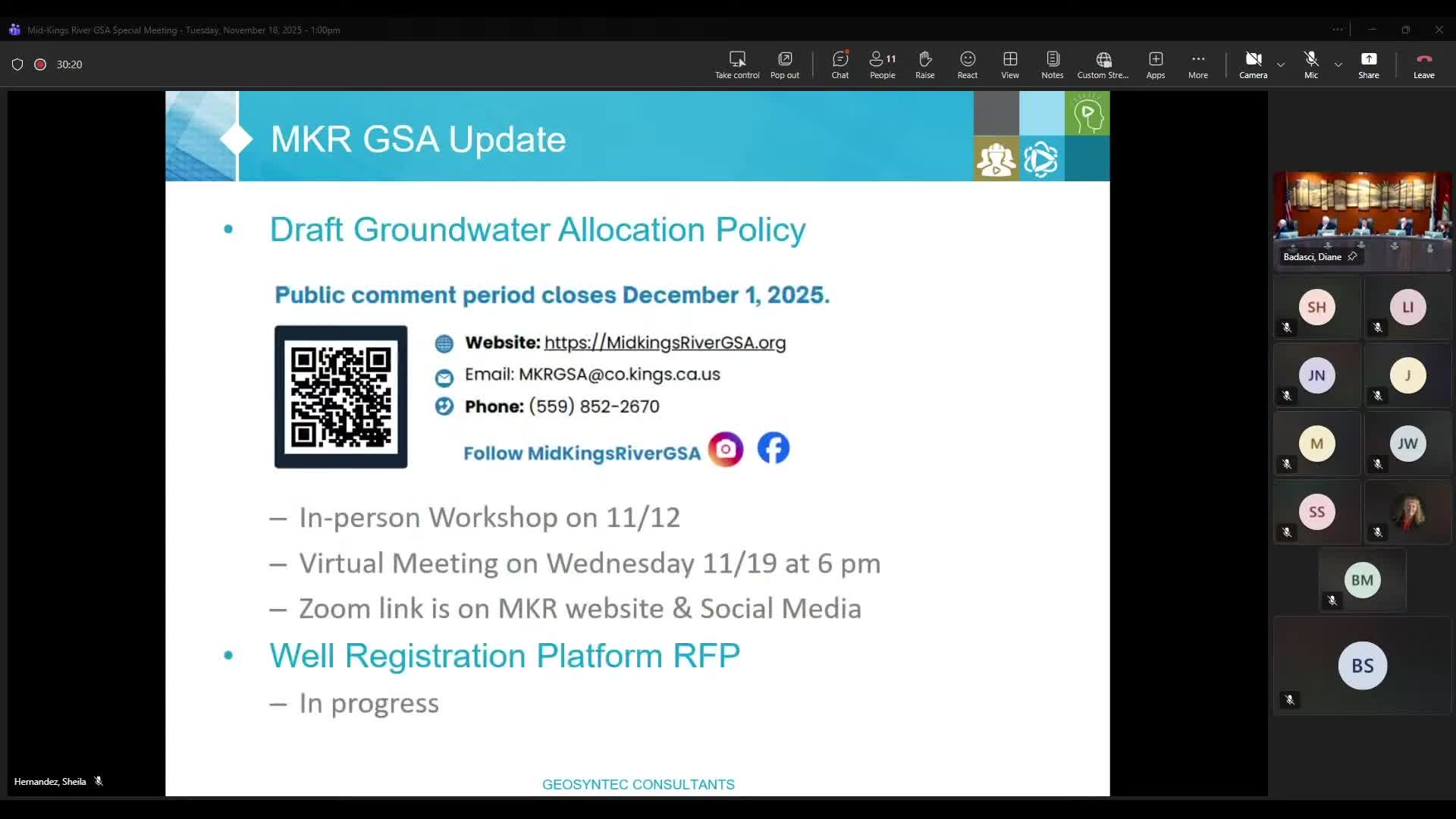
Summary
GSA staff said the revised Groundwater Sustainability Plan will be submitted by March 2026; the draft groundwater allocation policy is open for public comment through Dec. 1, with an in‑person and virtual workshop; staff also described a pilot domestic well mitigation program to evaluate four homes with wells that reportedly went dry.
Mid Kings River GSA staff on Nov. 18 reviewed next steps on the groundwater sustainability plan (GSP), urged public comment on an allocation policy, and described a pilot domestic well mitigation program for four homes.
Amir Hussain, the GSP consultant, said the GSA plans to submit a revised GSP by March 2026 so it can include pumping records the state expects by May 1, 2026 and to support a request for a fee‑exclusion or other SGMA relief. The draft groundwater allocation policy was released for a 45‑day public comment period that runs through Dec. 1; the GSA held an in‑person workshop for roughly 50 attendees and scheduled a virtual workshop for Nov. 19. "If you want a copy of that map ... contact Chuck," Hussain said, referring residents to staff for materials.
Staff also described outreach and technical work: a well‑registry RFP is under review, with about 30 days expected for proposals; staff tentatively expects to bring vendor recommendations to the stakeholder advisory committee and to the board in January and to launch the registry in March–April if the schedule holds.
On allocation methodology, staff disclosed a comment letter from the South Fork Kings GSA alleging Mid Kings' approach produces higher allocations than other GSAs in the Tulare Lake Subbasin and asked Mid Kings to withdraw and revise the policy. Chuck Kenny, the GSA’s general manager, and Hussain responded that Mid Kings used historical pumping share (Mid Kings accounts for about 36% of subbasin pumping) to allocate the sustainable yield and proposed 'blue pages' in the GSP to separate shared subbasin content from GSA‑specific figures.
On domestic well mitigation, staff said Self‑Help Enterprises identified four domestic wells the nonprofit believes went dry because of falling groundwater levels. The wells vary in depth from approximately 35 feet to more than 200 feet. All four are receiving interim water through Self‑Help Enterprises, staff said. The board asked how the program would handle cost allocation and whether assistance would be prorated for remaining life of older wells. Chuck Kenny said the current plan would provide a well or a connection to a water system to ensure an adequate household supply, and staff can consider revisions such as pro‑rata reimbursement or liens/0% loans to recover costs upon property sale. "That is something that...will be considered into the future where it could be a 0 interest loan," Kenny said.
The board did not take a formal vote on the pilot at this meeting but directed staff to develop cost estimates and return with recommendations on whether to treat one or multiple wells as pilots and how to structure cost sharing. Members pressed staff to ensure eligibility requires evidence the well went dry because of lowered groundwater levels rather than lack of maintenance.
During public comment, resident Desiree Woodworth said her parcel straddles Alta Irrigation District and Mid Kings and that Alta charged her roughly $3,400 while giving no answer on crediting Mid Kings; staff said they would contact Alta and follow up with her. The GSA said it will present all public comments to the stakeholder advisory committee before returning recommendations to the board.
Votes at a glance: approval of minutes from Oct. 2025 special meeting — 4 yes, 1 abstention (Robert Thayer).