Get Full Government Meeting Transcripts, Videos, & Alerts Forever!
Get email alerts on the Subsidence Management topic
No spam. Unsubscribe anytime.
Mid Kings River GSA adopts subsidence management policy with staged triggers and reporting requirements
Summary
The Mid Kings River Groundwater Sustainability Agency approved a subsidence management policy establishing grid-based monitoring with staged actions (meters and reporting at 40%, corrective orders at 50%, allocation reductions at 75%, and pumping prohibitions at 100%) to address land subsidence; the measure passed 4–0 with one member absent.
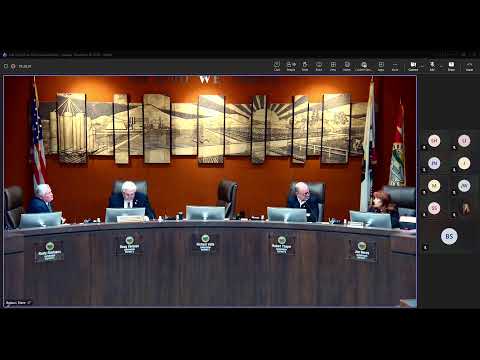
The Mid Kings River Groundwater Sustainability Agency on Nov. 18 approved a subsidence management policy that sets monitoring thresholds and enforceable responses aimed at limiting land subsidence across the GSA.
The board unanimously approved the resolution in a 4–0 vote with one member absent. Supervisor Rusty Robinson moved the measure and the roll call showed Doug Verboone, Rusty Robinson, Robert Thayer and Kimber Regan voting in favor.
The policy establishes a Jan. 1, 2020 baseline and divides the GSA into two-section-by-two-section grids to track cumulative subsidence. The maximum allowable subsidence varies by grid (roughly 4 to 7 feet depending on location). The policy creates staged actions tied to percentage triggers of that maximum:
- High‑risk (40% of the maximum): board will notify landowners in the affected grid, require well registration compliance, and move affected pumpers to meters and monthly reporting. - Corrective order (50%): restrictions on transfers of recharge credits into the lower aquifer and a prohibition on new lower‑aquifer wells in the affected zone. - Allocation reductions (75%): the GSA may begin reducing transitional allocations from the lower aquifer while still allowing pumping from upper aquifers. - Full restriction (100%): the GSA may prohibit pumping that contributes to subsidence.
“We are taking the subsidence issue very seriously,” Amir Hussain, the GSA’s consultant, told the board while reviewing the draft policy and its triggers. He said the start date was moved to 2020 to align with neighboring GSAs and to avoid being out of sync on monitoring and enforcement language.
Board members stressed the policy’s regional implications. Chuck Kenny, Mid Kings general manager, said the agency has identified critical infrastructure — including canals, ditches, county highways, rail corridors and supply wells — and has begun contacting infrastructure owners. He cautioned the board that limiting pumping by municipal well operators could be “tricky” and legally sensitive and said staff will engage cities and other large pumpers as discussions continue.
Supervisor Kimber Regan urged the board to balance protections for infrastructure with the economic impacts on local farming communities. Several board members said the staged framework aims to provide an early‑warning system while retaining tools to act if subsidence threatens critical assets.
The board passed the resolution after discussion and directed staff to return with implementation details, including outreach to identified infrastructure owners and the zone‑by‑zone enforcement plan. The meeting adjourned with a reminder that the GSA will next meet Dec. 9, 2025.
Votes at a glance: approval of the subsidence management policy — 4 yes, 0 no, 1 absent (Joe Neves).