
Candidates for Asheville planning and zoning seats outline housing, transit and flood‑resilience priorities
Get AI-powered insights, summaries, and transcripts
Sign Up Free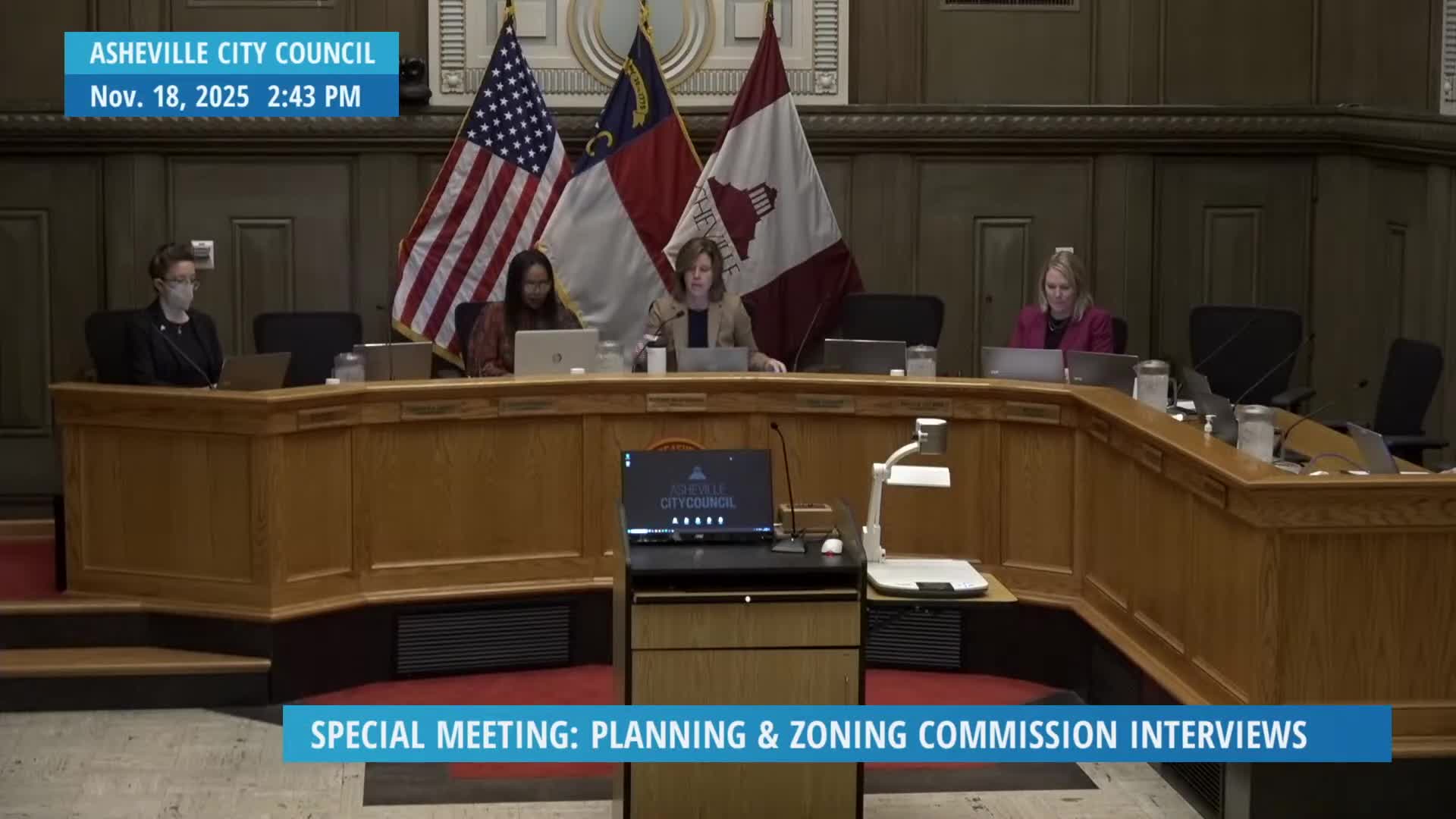
Summary
Five candidates interviewed for seats on the Asheville City Council Planning and Zoning Commission emphasized housing affordability, anti‑displacement measures, transit‑oriented density and flood resilience. The City Council planned to vote on appointments later the same evening; no votes occurred during the interviews.
Five candidates spoke before an interview panel convened by Asheville City officials, telling the panel they would prioritize housing affordability, anti‑displacement measures, transit‑oriented land use and stronger flood‑resilience rules if appointed to the Planning and Zoning Commission.
Michael Corbis Bischelli, introduced at the hearing as the first applicant, said he would start from the zoning ordinance and staff recommendations, weigh community input and seek a reasonable consensus on conditions attached to conditional‑zoning requests. “Rules are rules, and it's a conditional zoning request,” Bischelli said, adding that he would fall back on the zoning code as the guiding document for decisions.
Seth Connolly, a 20‑year Buncombe County resident and real estate agent, told interviewers he sees a market inflection point with recent vacancy in some large projects and urged implementing parts of the Missing Middle study to unlock denser housing types on smaller lots. “We have a lot of empty apartment buildings that have been … green‑lighted and developed over the past few years,” Connolly said, arguing the city should use the opportunity to expand smaller‑scale multifamily options and ease pathways for legacy homeowners to access equity.
Anthony Angelito, who identified himself as a city planner by trade, said zoning is “near the top” of the drivers for the housing shortage and cited experience in Austin with eliminating parking minimums and allowing three units by right on some single‑family lots. He said commission members should consider long‑term plans and calibrate decisions by neighborhood context.
Randall Barnett, a former city planning staffer, acknowledged past involvement in urban renewal and said he has come to oppose displacement while stressing compliance with existing zoning rules. Barnett noted the vacancy exists because a previous commissioner, Byron Greiner, died; his candidacy was for the remaining year of that seat. He urged aligning transportation planning with development to improve access for residents.
Lindsey Broll, with a master’s in urban planning who now works as a renewable‑energy developer, emphasized balancing flood‑plain protections with the need to preserve affordable places for artists and small businesses. Broll said the zoning code is a powerful tool that should provide guardrails for affordability, multimodal access and stormwater management without becoming exclusionary.
Across the interviews, candidates repeatedly framed decisions as case‑by‑case judgments that should be anchored to the city’s comprehensive plan or Unified Development Ordinance and informed by staff analysis, community input and equity considerations. On transit, several candidates advocated concentrating density where frequent, well‑served transit exists and ensuring developers help fund or support necessary transit infrastructure.
No formal actions or votes were taken during the interview session itself; the panel’s leaders told candidates the City Council would vote on appointments later the same night. The interviews were scheduled to run about 10 minutes per candidate, and panelists asked candidates about priorities, conditional zoning, anti‑displacement strategies and post‑Helene flood resilience.