
San Rafael staff present Canal neighborhood lighting concept as residents raise wildlife, safety and process concerns
Get AI-powered insights, summaries, and transcripts
Subscribe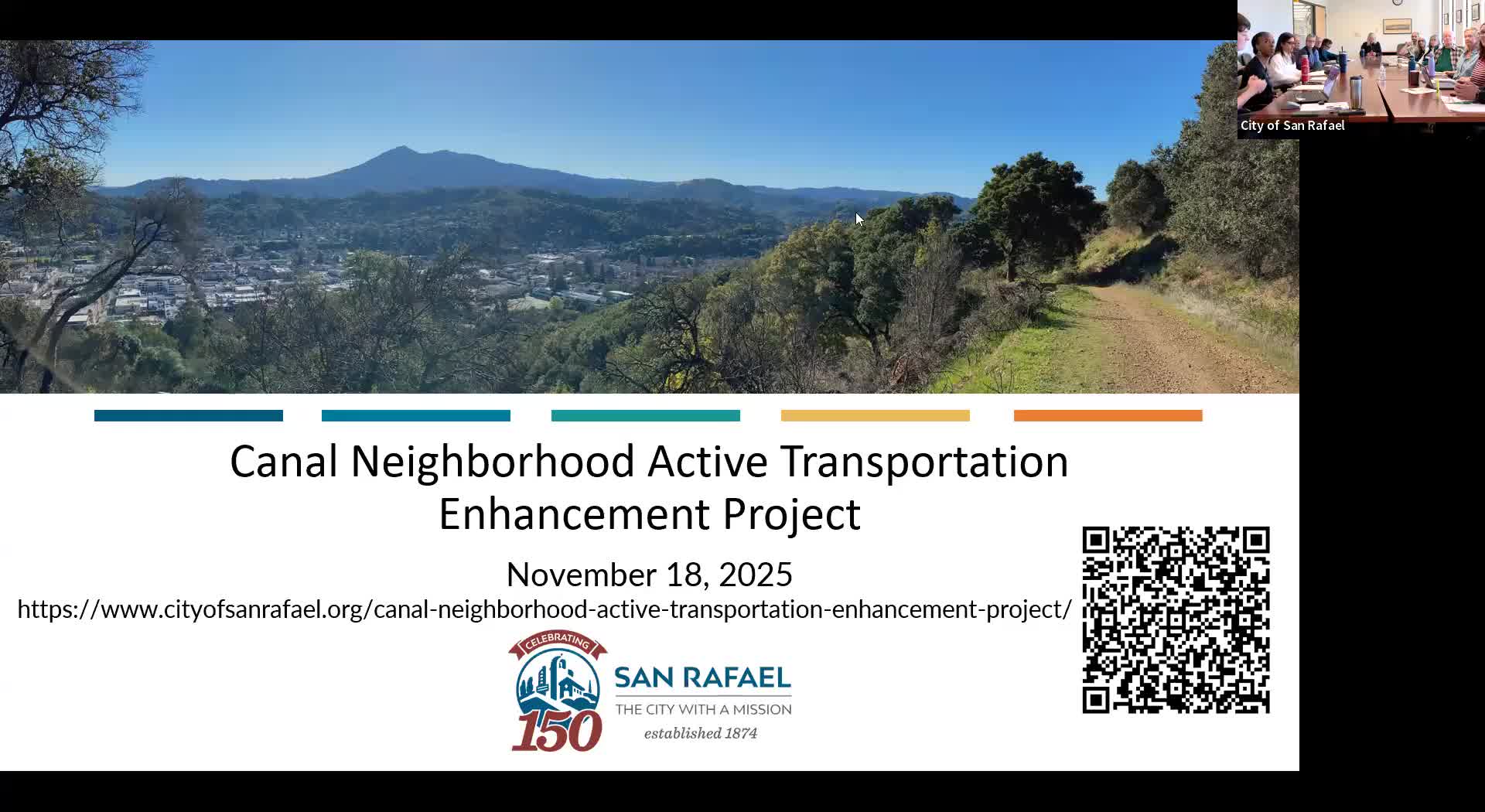
Summary
City staff presented corridor lighting options for the Canal Active Transportation Enhancement Project; residents questioned wildlife impacts, maintenance, crime data and outreach. Staff said environmental studies under CEQA are underway and a follow‑up meeting is set for Dec. 9; no decisions were made.
San Rafael staff on Tuesday presented conceptual street and pathway lighting designs for the Canal Neighborhood Active Transportation Enhancement (ATE) Project and took public questions on wildlife impacts, safety, maintenance and community outreach.
Gray Milgaard, senior civil engineer in the city’s Public Works Department, said the Canal ATE combines previous planning work — including the community‑based Canal transportation plan and the citywide bicycle and pedestrian plan — and that the lighting element began focused design work in late August after the project won an Active Transportation Program grant. "This is kind of the first conversation we're having," Milgaard said, describing proposed fixture types: 15‑foot overhead lights and 3.5‑foot bollards, with examples and consultant‑produced heat maps showing 20‑ to 25‑foot bollard spacing and roughly 100‑foot spacing for overhead fixtures.
The city said BKF Engineers holds the professional services contract for environmental review, design and construction support and that LSA is the environmental consultant currently performing technical biological studies and the CEQA determination. Assistant City Manager Angela Robinson Quinone told the room an environmental assessment will be completed as part of the CEQA process; staff cannot yet say whether that will be an Environmental Impact Report, a mitigated negative declaration or a negative declaration.
Police Chief Dave Spiller described a Crime Prevention Through Environmental Design (CPTED) review performed by the police department and framed the safety tradeoffs: "The more light, the safer you are," he said, noting that increased illumination helps officers and reduces some criminal opportunity, but also acknowledging that lighting can intrude on residents’ homes and potentially invite loitering where parks are formally closed at night.
Residents raised several recurring concerns. Bay Point Lagoons resident Dave Bonfiglio said some homeowner associations directly affected by proposed path lighting were not listed among early outreach and warned lighting could "attract more people" to areas that are meant to be closed after dusk. George Scott, who said he walks the path daily, urged staff to consider wildlife: "It should be dark at night for the animals," he said, noting nesting birds and ground animals in the lagoon area. Multiple speakers asked whether local environmental groups (for example, Audubon) had been consulted; staff said they have met with regional permitting agencies and will include agency input as part of environmental review.
Others pressed practical questions about maintenance, vandalism and durability. Several residents described cracked asphalt, downed fencing and ongoing graffiti along the trail; Bonnie Smolin said neighbors are worried increased lighting could fuel graffiti and other unwanted activity. Claire Taylor raised sea‑level rise concerns and asked whether fixtures would be designed for saltwater inundation and whether they would be electric or battery powered; staff said specific fixture types and placement have not been finalized and that these issues will be addressed during design and environmental studies.
Staff encouraged reporting maintenance problems via the SeeClickFix system and offered to help community members learn to use the reporting tool. April Miller, public works director, said a lighting contractor would maintain fixtures if installed and reiterated that the design work remains in preliminary engineering; construction funding is not yet secured and, absent other guidance, the lighting design would be brought to the City Council as part of the larger project in a later phase.
The meeting produced no votes or formal decisions. Angela Robinson Quinone said a follow‑up public meeting is scheduled for Dec. 9 and staff asked residents to sign up for project updates on the project website. Milgaard and other staff said they will continue outreach, refine placement to avoid the dirt recreational areas, coordinate with PG&E where undergrounding (Rule 20A) is already planned, and complete CEQA‑required environmental analysis before returning with a proposed design.
The city provided multiple opportunities for residents to submit follow‑up questions and materials; staff emphasized that the project remains in preliminary design and that community input will inform final recommendations.