
Committee extends review of Kailua shoreline SMA permit amid archaeological and sea‑level concerns
Get AI-powered insights, summaries, and transcripts
Subscribe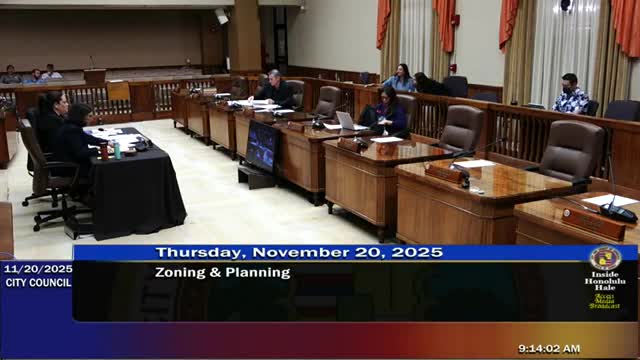
Summary
The Zoning and Planning Committee granted a 90‑day extension for a special management area major permit for a proposed two‑story shoreline dwelling in Kailua after DPP highlighted nonconformities, a State Historic Preservation Division request for an archaeological inventory survey, and significant sea‑level rise exposure.
The committee on Nov. 20 extended action on Resolution 25‑299 — a special management area (SMA) major permit application by Margaret Taylor for a new two‑story single‑family dwelling with two covered decks, an internal above‑grade pool and an attached eight‑car garage at 430 D North Kalaheo Avenue in Kailua.
DPP staff told the committee the project’s conceptual plans appear to conflict with residential development standards and that CD1 includes conditions requiring the new dwelling to have only one kitchen, one laundry room and a maximum of four bathrooms. The department noted the site is an approximately 23,256‑square‑foot shoreline lot and that roughly 90% of the project site will be impacted by an estimated 3.2 feet of sea‑level rise by 2100. Presenters said the proposal raises resilience concerns; the applicant intends to elevate habitable areas about four feet above grade and design a resilient foundation.
The State Historic Preservation Division in May 2025 requested an archaeological inventory survey (AIS) with subsurface testing because existing information was insufficient to rule out impacts to subsurface cultural deposits or kupuna (Native Hawaiian ancestral remains). DPP’s CD1 requires submission of the division’s written acceptance of the AIS and implementation of any required mitigation protocols.
Council members also criticized the frequency of incomplete SMA applications and urged industry groups to publish lists of qualified agents and architects. The applicant’s agent (Mark Holland of Well Environmental Services LLC) was not present in person; the chair said the absence hampered the committee’s ability to review plans. To allow more time for applicant engagement and for DPP technical checks, the chair recommended and the committee approved a 90‑day extension, subject to a written extension request from the applicant.
Next steps: DPP will expect a written extension request from the applicant; the committee’s extension preserves council review while DPP and the applicant address AIS, plan compliance and CD1 conditions.