Monrovia holds public hearing on proposed citywide lighting, landscaping and parks assessment; ballots to be counted Nov. 19
Loading...
Summary
Monrovia held a lengthy public hearing on a proposed Citywide Lighting, Landscaping and Parks Maintenance Assessment District (No. 2025‑1). Staff said the five‑year phase‑in is intended to close an ongoing maintenance funding gap; opponents cited affordability, ballot weighting and outreach concerns. Ballots will be publicly tabulated Nov. 19.
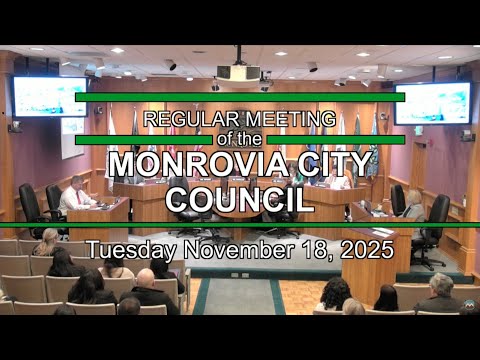
The City of Monrovia on Nov. 18 held a public hearing on the proposed Monrovia Citywide Lighting, Landscaping and Parks Maintenance Assessment District No. 2025‑1, a plan staff says will combine two decades‑old maintenance assessments and phase in new, parcel‑specific charges over five years to close a growing deficit.
Ray Bowman, city staff, outlined the proposal and the legal and procedural framework: "This evening's public hearing is for the proposed Monrovia Citywide lighting, landscaping, and Parks maintenance Assessment District Number 2025 Dash 1," and he described that the proceeding follows the Landscaping and Lighting Act of 1972, Article 13d of the California Constitution and Assembly Bill AB 2257. Bowman said the engineer's report allocates 19.33% of costs as general benefit (the city's responsibility) and assigns the remainder as special benefit charged to parcels; the council approved a five‑year phase‑in to reduce first‑year impacts. Staff said all ballots must be received by the close of the hearing and that ballot tabulation will begin Nov. 19 at 9 a.m. in council chambers.
Dozens of property owners and residents testified during the hearing. Opponents said the assessment would be unaffordable for many homeowners and unfairly weighted by parcel assessment amount. "I can only imagine some of the other properties that have larger ones; this will be quite a burden," said Lynn Lewis, a Monrovia homeowner. Other speakers questioned outreach, saying paperless customers and some renters may not have received clear notice; several residents said the mailed ballots resemble junk mail and may be discarded. Multiple commenters raised legal and fairness questions about whether the assessment amounts satisfy Prop 218's special‑benefit test.
Speakers also pressed staff on alternatives and on whether the engineer's report considered energy‑efficiency upgrades. Jason Samiwalli, who asked that the council consider life‑cycle and baseline energy cost analyses, urged the city to examine energy performance contracting as a way to finance upgrades through guaranteed savings. Staff responded that the proposed assessment focuses on operations and maintenance and does not include a large upfront capital program, though the city will continue exploring financing and partnership options. City Attorney and staff reiterated that assessment ballots are counted and weighted by assessment dollar amount, not "votes" in the general‑election sense, and explained that the Prop 218 process permits an assessment proceeding and a separate vote threshold than a special tax.
At the close of the public hearing the council accepted and considered oral and written testimony and directed staff to tabulate assessment ballots at the designated time and place. Staff reminded the public that the city clerk, with assistance from NBS, will determine whether a majority protest exists (based on weighted ballots) and that the council is tentatively scheduled to consider adoption or written responses to objections Dec. 2.
What happens next: Ballot tabulation will begin Nov. 19 at 9 a.m. in council chambers and the council will review the tabulation and take formal steps at the Dec. 2 meeting. If a majority protest exists under Prop 218 rules, the council cannot impose the assessment.
Reporting note: Quotes and attributions in this story come from the public record of the Nov. 18 Monrovia City Council meeting.