Get Full Government Meeting Transcripts, Videos, & Alerts Forever!
Get email alerts on the Zoning Helistop topic
No spam. Unsubscribe anytime.
Huntersville hears request to allow private helistops; staff urges denial
Summary
At a Nov. 18 public hearing, staff recommended denial of a text amendment that would permit private helistops in general residential zones, citing noise, tree‑clearing and neighborhood character concerns; applicant Todd Hirschfeld said he seeks limited private, FAA‑compliant daytime use and asked for case‑by‑case review.
A Nov. 18 public hearing in Huntersville centered on text amendment TA25‑01, which would allow private helistops in the town’s GR (general residential) zoning district under conditions the applicant proposed: private‑use only, daytime landings, and no on‑site fueling, maintenance or commercial operations. Town staff recommended the board deny the amendment, saying it raised neighborhood‑character and nuisance risks and did not align with the town’s 2040 community plan.
Becca, a planning staff member who presented the item, told the board that the proposed amendment would expand current allowances (which permit helistops as accessories to campus, institutional and commercial uses) into residential areas and that staff had “some concerns regarding this text amendment, The first being potential nuisance to the next door neighbors or to residences, the noise and the wind that could be made from a helicopter, the potential tree clearing that would be needed for a safe flight path.” She also said the 2040 plan’s land‑use recommendation 11.1 directs the town to protect the character of Huntersville neighborhoods and that, for those reasons, “staff does recommend denial of this text amendment.” Staff suggested that, if the board wished to permit residential helistops, it should be through a special‑use permit so proposals could be reviewed case by case.
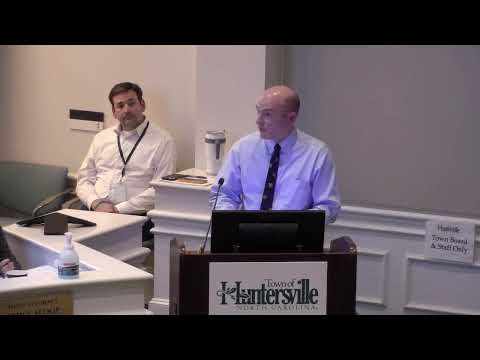
The applicant, Todd Hirschfeld, told the board he is an experienced pilot who owns the lot in question and said he was seeking limited, private daytime operations in compliance with FAA rules. “I’m not looking to do any commercial use,” Hirschfeld said, and he repeatedly emphasized that he would operate within FAA guidance and accepted noise‑abatement practices. He told the board he had three neighbor letters of support and argued an individual departure or arrival lasts far less than some residential noise sources: “My normal departure helicopter time is about a minute and 30 seconds from when I crank until I depart, and it’s much less when I’m landing.” He also said most local helipads he cited as precedent are on docks and regulated by Duke Energy.
Commissioners pressed staff and the applicant for specifics about setbacks, the number of nearby properties affected and whether trees would need to be cleared to create a safe flight path; staff said initial measurements suggested the pad was roughly 20–30 feet from a lot line but asked the applicant to provide exact lot‑line distances. The board heard that other municipalities seldom allow helistops in single‑family residential contexts; staff noted Charlotte permits limited neighborhood helistops only under narrow place‑type rules and that most nearby helipads are accessory to medical, government or commercial uses.
No formal vote on TA25‑01 occurred at the meeting. Staff said the text amendment will go before the planning board the day after the meeting and return to the board of commissioners for final action on Dec. 16.
What happens next: The planning board will review the proposal and staff recommendations; the board of commissioners will consider final action at its Dec. 16 meeting.