Get Full Government Meeting Transcripts, Videos, & Alerts Forever!
Get email alerts on the Land Use Waterside topic
No spam. Unsubscribe anytime.
Martin County commissioners deny Waterside text and map amendments after debate over capacity methodology
Summary
The board voted unanimously to deny a site‑specific comprehensive plan text amendment (CPA 21‑11) and the related future land use map amendment for the Waterside parcel, with staff saying required criteria were not met and the applicant arguing the county’s residential capacity methodology is flawed.
The Martin County Board of County Commissioners denied a developer‑backed comprehensive plan text amendment and, later in the meeting, a linked future land use map amendment that would have converted 396 acres known as the Waterside property from agricultural to low‑density residential.
Staff presented CPA 21‑11 and an accompanying CPA 21‑12 future land use request and recommended denial. Senior planner Jenna Nobby told the board staff had analyzed the county’s policy criteria for expanding the primary urban service district and concluded the application failed to demonstrate compliance with policy 4.787 subsections 1, 2 and 5 — specifically internal consistency with the comprehensive plan, compatibility with adjacent uses, and that reasonable capacity does not exist within the existing primary urban service district. "Compliance with criteria 1, 2 and 5 had not been met by this application," Nobby said during the presentation.
Applicant representatives said the Waterside parcel is surrounded by developed urban service districts and existing utilities. Attorney Tyson Waters and planner Morris Crady argued that the site is appropriate for infill housing and that the county’s residential capacity numbers overstate available supply. Crady described commitments the applicant would accept if amendments passed, including processing future development as a planned unit development (PUD), capping density and funding infrastructure: "We're willing to pay $1,000 per residential unit or over $1,000,000 to help the county with affordable housing projects," Crady said.
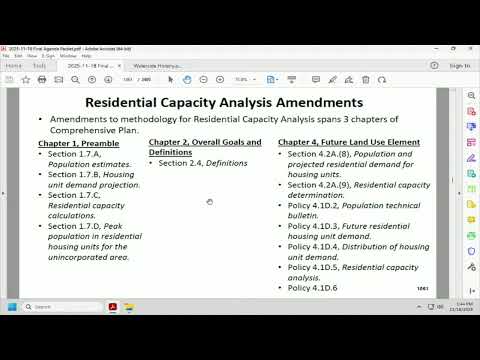
GAI Consultants’ Laura Smith, retained by the applicant, testified at length about what she called flaws in the county’s residential capacity analysis and the population technical bulletin used to estimate demand and supply. Smith told commissioners the county’s 2025 population technical bulletin was the first adopted since 2017 and that published methodologies and data sources had not been consistently applied; she proposed alternative adjustments — for example, applying realistic upland‑only multipliers on parcels with extensive wetlands and using a five‑year vacancy average — that, in her analysis, reduced assumed 'reasonable capacity.' "The 2025 bulletin is the first population technical bulletin that has been produced since 2017," Smith said, arguing that prior capacity calculations could not fully follow the comp plan methodology without the bulletin.
Commissioners debated the technical and policy questions. Commissioner Hetherington moved to accept staff’s recommendation to deny the text amendment; Commissioner Vargas seconded and called the proposal "sprawl." After discussion, the board voted to deny the text amendment unanimously. After procedural clarification at the applicant’s request, the board took up the future land use map amendment (CPA 21‑12). Staff again recommended denial, citing compatibility concerns, urban sprawl indicators under state law and a lack of available public facilities to serve up to 1,050 additional residential units. The board voted unanimously to deny the map amendment as well.
What happens next: The denials are legislative land‑use decisions. The applicant may pursue administrative options available under county and state procedures, but the commission relied on staff’s findings about plan consistency, capacity methodology and public‑facility availability in reaching the decisions.
Votes at a glance: Text amendment (CPA 21‑11): motion to deny carried unanimously. Future land use map amendment (CPA 21‑12): motion to deny carried unanimously.
Funding and commitments noted in testimony: Waterside parcel ~396 acres; applicant proposed a cap of roughly 1,050 units and a developer contribution of $1,000 per unit to the Martin County Community Land Trust; applicant said infrastructure and utility extensions would be developer‑funded if the project moved forward.