Get Full Government Meeting Transcripts, Videos, & Alerts Forever!
Get email alerts on the Police Equipment topic
No spam. Unsubscribe anytime.
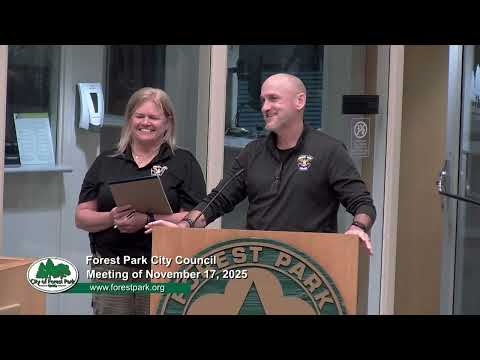
Forest Park council approves bundled Axon policing contract after presentation and debate
Summary
After a police presentation on equipment needs and costs, the Forest Park City Council voted 6–1 to authorize a multi-year bundled contract with Axon for body and in-car cameras, digital evidence storage, TASER devices and related services. Councilmember Clark voted no citing long-term flexibility concerns.
Forest Park’s City Council on Nov. 11 approved a resolution authorizing the city manager to contract with Axon to provide body-worn cameras, in-car cameras, TASER 10 devices, redaction and transcription software, translation services and cloud-based evidence storage.
The authorization, adopted as Resolution 40-2025, followed a presentation by a police representative (identified in the meeting as Harlita) who said the department currently maintains four separate contracts with Axon for those products and is seeking to consolidate into a single bundled agreement. Harlita told council that under the city’s current staggered approach the department faces rising storage demands and that “you’re looking sometimes 1 to 2 terabytes in a homicide case,” and that bundling would produce savings over time. She laid out 5‑year standalone estimates (body-worn $213,000; in‑car $320,000; tasers $242,000; storage $132,000) and said the current piecemeal approach would total roughly $909,000 over five years.
Harlita said Axon’s 10‑year bundled proposal totaled $1,531,000 (about $153,000 per year) and that “we would save approximately $106,000 over that 10 year period” versus the department’s 5‑year projection, and that the bundle also yields nearly $300,000 in savings compared with continuing the current contract renewals. She described Axon’s TAP program as including scheduled equipment refreshes — body cameras roughly every 2.5 years, in‑car cameras every 5 years and TASER replacements at 5 years — and said the city retains ownership of its data in the vendor’s cloud.
Council members pressed for contract details including whether the contract text guarantees receipt of new-generation devices, payment timing flexibility, grant-seeking to offset costs and the city’s options if appropriations are unavailable later. The presenter said some TAP benefits are explained outside the core contract and that payment schedules can be structured; she also said the contract contains an appropriations clause that would allow the city to exit if funds are not available, but the city would have to purchase equipment to keep it in that case.
Councilmember Clark cast the lone vote against the measure, saying she was not convinced the projected cost savings justify locking the city into a longer-term arrangement. The roll call on Resolution 40-2025 was: Holt (yes), Moore (yes), Sylvester (yes), Adams (yes), Brown (yes), Clark (no), Harrison (yes). The resolution passed 6–1.
The mayor and police officials emphasized operational and litigation risks if the city were to forgo body or in-car cameras. Harlita said cameras and linked in‑car footage help the department disprove false claims and lower exposure to lawsuits, and warned that Axon is winding down support for older TASER cartridges, meaning replacement supply and warranty coverage for expired devices is limited.
Next steps: the resolution authorizes the city manager to execute the contract; council and staff said they will continue to pursue available grants to reduce the city’s net cost and to monitor implementation details, including equipment counts (the presenter cited contract pricing based on 37 body cameras and 17 cruisers).