Get Full Government Meeting Transcripts, Videos, & Alerts Forever!
Get email alerts on the Housing topic
No spam. Unsubscribe anytime.
Council debates joining Oregon's moderate-income revolving loan program, delays ordinance work
Summary
Milwaukie council heard detailed presentations from city staff, OHCS advisers and developers about the state MURAL program (no-interest loans converted to local grants via tax exemptions). Concerns about county IGAs, city liability and staff capacity led council to defer drafting an originating ordinance until rulemaking and county conversations advance.
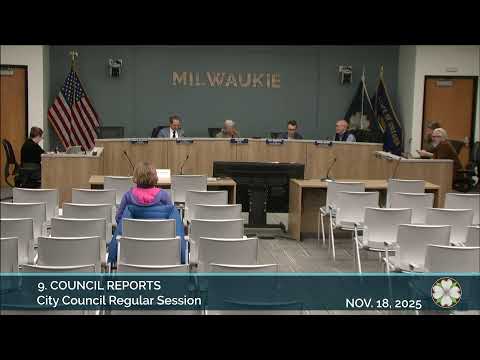
City officials devoted substantial time Tuesday to whether Milwaukie should adopt an "originating ordinance" to participate in Oregon's moderate-income revolving loan program (known in discussion as MURAL). The program provides no-interest state loans to sponsoring jurisdictions that are converted into grants for qualifying housing projects through temporary property-tax exemptions.
"All taxing districts are exempt other than fire districts," Jason Mackey, a technical adviser with the Oregon Housing and Community Services Department (OHCS), told the council while clarifying how the state program treats local taxing districts. Mackey also clarified that OHCS intends to implement technical-rule changes by 2026 but there is not a hard January 1 deadline for those rules.
City staff and OHCS described the mechanics: the sponsoring city or county applies for state loans, converts funds to grants for developers, and then the temporary tax exemption on improvements helps repay the state loan through a pass-through to OHCS. Staff emphasized that the originating ordinance creates a local program (including a compliance plan) but does not obligate the city to accept any project applications.
Councilors pressed on several operational and financial questions: who signs IGAs with the county, whether the county must agree to participate before the city can implement projects, and whether the city would carry financial liability if a developer or project defaults. One councilor summarized a concern repeatedly raised by others: "If the project itself defaults, if the developer defaults ... the city is on the hook for the whole loan, not just that one house." (council comment paraphrased from the public exchange).
OHCS and state program staff said the originating ordinance typically precedes the IGAs and that the county is a required partner; OHCS recommended early conversations with the county. Megan Ellers, introduced as "the mural program manager," described compliance-plan elements used by other jurisdictions (Coos Bay, Tillamook County) to document how affordability will be maintained and reported.
Developers who have been talking to OHCS urged the city to move quickly. A development partner identified as Austin said the loan program could cover land costs that otherwise make affordable for-sale units infeasible and noted the state allows a 5% administrative fee within loans to support local program staffing.
Council debate split: some members said this is an important funding opportunity that could produce dozens of affordable units locally; others warned the program is process-heavy, carries potential city liability and would require staff capacity and coordination with Clackamas County. The mayor proposed returning with a check-in after OHCS rulemaking progresses and after county outreach; several members suggested returning in March or April for a follow-up briefing instead of directing staff immediately to draft an ordinance.
Result: Council did not adopt an originating ordinance or vote to opt in. Members asked staff to continue outreach with the county, to track state rulemaking and to return with a clearer staffing and budget picture before any ordinance drafting.
Next steps: staff will pursue county conversations and return to council in the spring with more detailed proposals and staffing implications.