Get Full Government Meeting Transcripts, Videos, & Alerts Forever!
Get email alerts on the Large Development topic
No spam. Unsubscribe anytime.
Commission backs seven‑year phasing plan for Dorsey Marketplace, despite objections over expired approvals
Summary
The commission recommended City Council allow the Dorsey Marketplace project to be constructed in phases over seven years, accepting an addendum to the project EIR; opponents argued the project approvals had expired and the phasing plan lacked enforceable milestones.
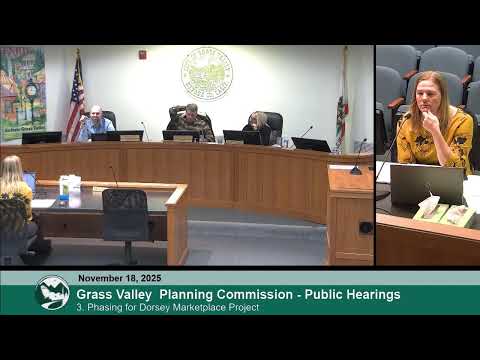
The Grass Valley Planning Commission voted Nov. 18 to recommend City Council approve an amendment allowing the Dorsey Marketplace project to be constructed in phases over a seven‑year period, following staff’s addendum to the previously certified EIR.
Staff told the commission the Dorsey Marketplace approvals date to earlier council actions and that a subsequent EIR and court process led to a timeline that the applicant must now follow; staff prepared an addendum concluding that the proposed phasing does not require a subsequent or supplemental EIR. Applicant representative Warren Hughes, participating remotely, said the full buildout is approximately a $70,000,000 investment and that phasing is necessary to accommodate site remediation, infrastructure improvements, tenant acquisition and financing. “The owners would love nothing more than for it to go faster,” Hughes said, “but the reality of negotiating with major tenants, finalizing those leases can take a year or two and then financing to build this project.”
Opponents including Ralph Silverstein of the CEA Foundation argued the approvals had expired and urged denial, saying the phasing plan lacked measurable early milestones and could allow the project to remain dormant for years. Silverstein told commissioners the approvals “expired on September 10” and that the Planning Commission lacked legal basis to reinstate an expired permit without additional legal justification. Staff and the applicant replied that the court certification timeline affects the expiration calculation and that the developer submitted for an extension of time as a precaution.
Commissioners asked whether entitlements would remain vested if city standards change; staff answered that approvals are generally vested to the standards in force at the time of approval, though specifics depend on the nature of future changes. After discussion, the commission moved, seconded and voted 3‑0 to recommend City Council approve the phasing amendment and adopt the EIR addendum.
The recommendation will be transmitted to City Council, which must approve the amendment and associated findings for the change in the project’s condition of approval. If Council approves, the developer will be permitted to construct the project in phases subject to the phasing schedule and any conditions imposed by council and the city.