Planning commission recommends Gates Place 16‑lot affordable subdivision to city council
Loading...
Summary
The commission recommended City Council approval for the Gates Place Subdivision: a 16‑lot, two‑phase, 100% deed‑restricted affordable housing project by Habitat for Humanity, along with rezones and an RHNA overlay and a mitigated negative declaration; staff and applicant stressed drainage, fire‑safety landscaping and walkable access.
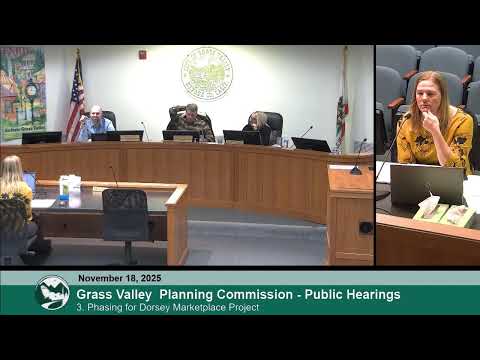
The Grass Valley Planning Commission on Nov. 18 recommended City Council approve the Gates Place Subdivision, a 16‑lot tentative map proposed by Habitat for Humanity that would be 100% deed‑restricted affordable housing and require multiple discretionary entitlements including a rezone to add a Regional Housing Needs Allocation (RHNA) combining district overlay, zoning and general plan text amendments, a major development review and a planned development permit.
Associate Planner Vanessa Franken briefed commissioners that the project site is in the Brunswick community on the west side of Highway 49 and currently carries a Business Park (BP/CBP) general plan and zoning designation. Because the applicant seeks a residential‑only affordable project on property designated BP/CBP, staff recommended a general plan text amendment and a zoning text amendment to create an RHNA overlay that would permit 100% deed‑restricted affordable housing when projects meet the municipal criteria.
Vanessa Franken said the project proposes two phases, a tentative subdivision map for 16 lots, a community garden, a 4‑year build‑out request due to market and funding conditions, and a mitigated negative declaration with a mitigation monitoring and reporting program. The staff report notes on‑site drainage connections exist, NID will provide water and wastewater service, and the project includes bio‑retention features that the applicant described as passive “sponge” systems to handle storm events.
Martin Wood (SCO Planning & Engineering) and Habitat representatives described site planning decisions that retained natural topographic indentations as bio‑retention ponds, proposed two‑bedroom through four‑bedroom unit types with universal design features, and a community garden located on an upper corner of the site to promote resident amenity and environmental preservation. Wood said the layout was chosen to minimize infrastructure costs and to meet defensible‑space and emergency‑vehicle standards.
Public commenters expressed strong support for the project’s affordable‑housing aim: developer‑supportive comments included Bob Brenstrom and Denny Silverstein praising the design and walkability. An online commenter raised concerns about Olympia Creek and habitat; staff responded that a certified biologist conducted a pedestrian survey and that the State Department of Fish and Wildlife dataset identified no protected wetlands on the parcel. Staff said any biological impacts identified in the initial study have mitigation measures in the MMRP.
After a short discussion and questions about drainage, access and landscaping, a motion to recommend City Council approval (including adoption of the initial study/mitigated negative declaration and the MMRP) passed 3‑0. The commission’s recommendation will be transmitted to City Council for final action; the project still requires council approval of the rezone, text amendments and tentative map and then the applicant must pursue building permits and any conditions tied to the approvals.
The staff report includes specific landscape and fire‑safety requirements and a staff‑based approval pathway for future landscape adjustments should fire‑safety policies evolve. NID, PG&E and the city’s police and fire departments are listed as service providers in the project materials.
Commissioners praised the project’s walkability, the inclusion of a community garden and its potential to add deed‑restricted affordable housing in an underutilized portion of the city.