Bradley County fire leaders warn understaffing and aging fleet risk safety; request $3.2M first-year budget increase
Loading...
Summary
Bradley County Fire Rescue told commissioners it faces critical staffing and equipment shortfalls, citing a 31% retention rate and a starting pay of $38,000. Fire leaders asked for $1.34M in immediate salary increases, 12 additional personnel and options to fund apparatus replacement, totaling about $3.22M in the first year.
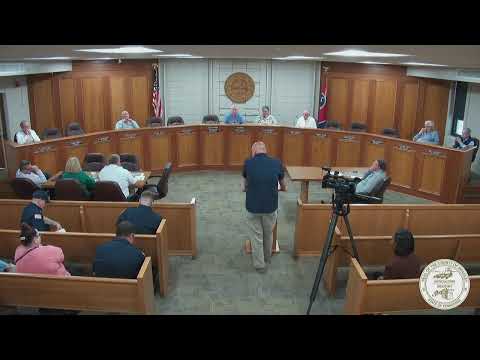
Bradley County Fire Rescue leaders told the county commission at a public meeting that low pay, high turnover and an aging fleet are creating safety and operational risks, and they asked commissioners to consider a multi-million-dollar increase in the department budget during the upcoming budget cycle.
“No one wants to lose qualified people, but we are losing them to neighboring agencies that pay more,” said Noah Scribe, a lieutenant and president of the Bradley County Fire and EMS Association. Scribe said the department’s starting pay is $38,000 and that its retention rate is about 31 percent. “We’re requesting immediate increase to stop the bleeding,” he said, asking the commission to approve $1,336,421.39 for salary and benefits changes in year one and an additional $680,784 to staff 12 more full-time personnel.
The presentation laid out two options for replacing apparatus. Option 1 would add roughly $1 million a year for three years to buy one engine a year and then maintain a $500,000 annual replacement contribution; Option 2 would use $3–4 million from capital funds to buy three engines immediately and then fund a $500,000 annual apparatus replacement line. Scribe estimated individual unit costs at roughly $1.2 million for an engine, $2.5 million for a ladder truck and $400,000 for a tanker.
Battalion Chief Justin Greylus, speaking from operational experience, described the toll on crews: “My officers…the pillars holding the department up are at a breaking point,” he said, citing repeated training of new hires who later leave for higher pay. Greylus and other speakers warned that older apparatus and worn personal protective equipment increase maintenance costs and can reduce frontline capability.
Chief Stewart told commissioners the department currently operates 13 stations (8 career, 5 volunteer), about 67 active full-time firefighters and roughly 35 volunteers. He said the fleet has about 39 apparatus with the majority older than 10 years, some over 20, and that parts for older vehicles are often hard to obtain. Stewart noted the department’s ISO rating recently improved from a class 4 to a class 3 — a change that can affect insurance ratings — but cautioned that many units are past NFPA-recommended service life.
The presenters cited NFPA standards as the industry benchmarks they are trying to meet; they described NFPA 1901 and operational guidance under NFPA 1710 and NFPA 1720 about crew sizes and deployment. They also provided examples of recent maintenance bills for aging engines (Engine 5 about $53,000; Engine 11 about $20,000; Engine 13 about $28,000) to illustrate rising upkeep costs.
Operational demands were described as significant: officials said the department averages about 250–300 calls per month (roughly 3,000–3,100 annually) and handles a range of incidents from medical calls to multi-structure fires and hazardous-material responses. Mutual-aid partners include Cleveland Fire and neighboring county agencies.
On technology, the department reported moving toward a consolidated CAD-integrated reporting and notification system to replace multiple services; staff estimated the software subscription near $20,000 per year and said hardware (in-vehicle computers) would be an additional capital cost to equip paid apparatus.
Commissioners thanked presenters and repeatedly said the request will be studied between now and the budget cycle. Commissioner Thompson said commissioners will need to “think about hard” how to fund the priorities; Commissioner Winters urged the presenters to engage the public, noting any tax or funding decision will require public buy-in. Presenters said they delivered a petition with over 700 signatures supporting increased funding.
No formal appropriation or vote on the funding request was taken at the meeting. Commissioners signaled they will consider the proposals during the regular budget process and indicated the department should supply any additional cost breakdowns or options requested by staff.
What’s next: department leaders asked the commission to prioritize immediate salary stabilization and to include apparatus replacement and equipment upgrades as items for the upcoming budget deliberations.