Get Full Government Meeting Transcripts, Videos, & Alerts Forever!
Get email alerts on the Climate Plan topic
No spam. Unsubscribe anytime.
Minnetonka commission reviews Climate Action and Adaptation Plan and recommends 2026 work plan to council
Summary
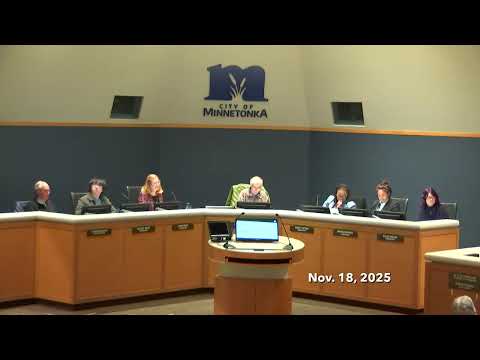
At its Nov. 18 meeting the Minnetonka Sustainability Commission received an update on the city's Climate Action and Adaptation Plan, heard staff's draft implementation roadmap, and voted unanimously to recommend the 2026 commission work plan to the City Council.
The Minnetonka Sustainability Commission on Nov. 18 heard an extended staff briefing on the city's Climate Action and Adaptation Plan (CAP) and voted to recommend a 2026 commission work plan to the Minnetonka City Council.
City staff member Ali presented the CAP background, goals and implementation approach, saying the plan was developed with community input in 2023, recommended by the commission and adopted by the city council in 2024. Ali described early accomplishments since adoption, including six publicly available electric-vehicle chargers (three fast chargers), five electric vehicles in the municipal fleet, solar installations on three city facilities and about 2,700 residents enrolled in curbside organics collection.
The presentation summarized climate risks Minnetonka faces (hotter summers, heavier precipitation and more freeze-thaw cycles), and reviewed the city's 2021 greenhouse-gas inventory, which staff used as the CAP baseline. Ali said buildings and vehicle travel are the largest community sources: in the 2021 inventory building energy represented about 54% of emissions and vehicle travel about 44%. She also noted municipal operations account for roughly 1% of community emissions, underscoring the need for broad resident and business participation.
Ali outlined the CAP's primary targets: a community-wide reduction of greenhouse-gas emissions of about 63% per person and per business by 2030 (measured from a 2018 baseline) and a net-zero goal by 2050. The plan lists 50 strategies across city processes, buildings and fleet, natural resources, interjurisdictional collaboration, education/outreach and incentives. Staff said it has converted the strategy list into roughly 150 candidate tasks and has unofficially consolidated and prioritized about 45 strategies to form a draft implementation roadmap and quarterly Gantt timeline.
After questions and clarifications from commissioners about adaptation examples and chart differences, the commission moved to item 5B, the draft 2026 Sustainability Commission work plan. Ali said the revised draft incorporated feedback from a Sept. 16 review and emphasized ambassador events, outreach tables, reuse swaps, business-targeted outreach blitzes and an Everything Electric exhibit as priorities. The proposed commission work plan also anticipates two onsite educational tours and biannual CAP implementation updates to the commission (January and June).
Commissioner Ashley moved to approve and recommend the 2026 Sustainability Commission work plan to the City Council; the motion was seconded and adopted in a unanimous roll call. Staff will forward the recommended work plan to the City Council for consideration and continued implementation planning.
The commission will next meet Jan. 20, 2026 for a staff update and further work-plan scheduling.
Notes: The CAP adoption year (2024), the 2021 inventory baseline, population and household counts (56,162 residents and 25,240 households cited by staff), the 2030 and 2050 targets and the implementation counts (50 strategies, ~150 tasks consolidated to ~45 prioritized strategies) were reported by staff during the presentation.