
Logan council approves narrower infill rules after debate over cul‑de‑sacs and shared driveways
Get AI-powered insights, summaries, and transcripts
Sign Up Free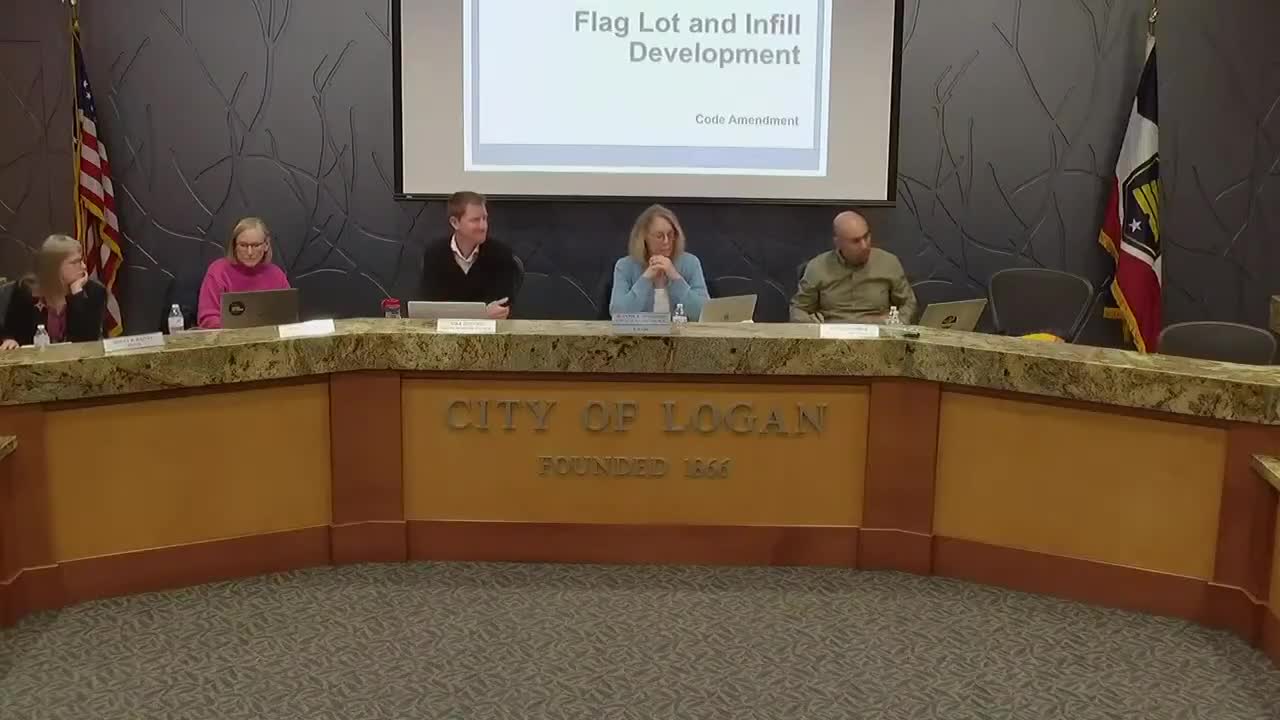
Summary
The Logan City Council approved an ordinance to amend the city’s infill code, changing flag‑lot and middle‑of‑block rules, reducing some lot‑size multipliers, tightening setbacks and allowing smaller private‑street cross‑sections. Council debate centered on emergency access, neighborhood character and whether cul‑de‑sacs should remain an option.
The Logan City Council voted to adopt amendments to the city’s infill provisions, approving changes the planning commission had forwarded after a 4–1 vote.
City staff said the revisions aim to better manage multifamily infill and flag lots while preserving neighborhood character. Staff proposed reducing the lot‑size multiplier for some flag lots (from 150% toward 100% in select cases), increasing setbacks to create buffers, and standardizing driveway and setback dimensions. For middle‑of‑block infill, staff proposed limiting small projects to three to six units and allowing a narrower private‑street cross section (36 feet) with sidewalk on one side to make small infill projects more feasible.
Vasali, a community development staff presenter, told the council that the amendment was intended to strike a balance between encouraging efficient infill and preventing overcrowding. "We just put a cap on it," Vasali said, describing options to require perpetual easements for shared driveways and fire‑department review of emergency access.
Council members questioned practical details. Speakers pressed staff on whether shared driveways and easements would be perpetual and how emergency access would be guaranteed; Vasali answered that the fire department reviews every proposal and that perpetual easements are a common condition. Several members raised concerns about neighborhood character and whether options such as cul‑de‑sacs or hammerheads should remain available. One council member said a cul‑de‑sac "takes up a lot of space" and is often the least chosen turnaround in tight infill situations; others argued that retaining options preserves flexibility for unique sites.
After discussion, Speaker 6 moved to approve the ordinance, Speaker 3 seconded, and the council approved the measure by voice vote.
Votes at a glance Ordinance to amend infill/flag‑lot code (referred to in meeting as "ordinance 50 or 25 20") — Motion to approve made by Speaker 6, seconded by Speaker 3; approved by voice vote. No recorded nays were announced in the public minutes.
What happens next Staff will incorporate any required edits and the revised code will be implemented according to the adopted ordinance. Staff and the planning commission will continue to apply conditions (such as perpetual easements and fire‑safety measures) during project review.