
Beacon board weighs adding School Resource Officer; superintendent to return in December with budget and outreach plan
Get AI-powered insights, summaries, and transcripts
Subscribe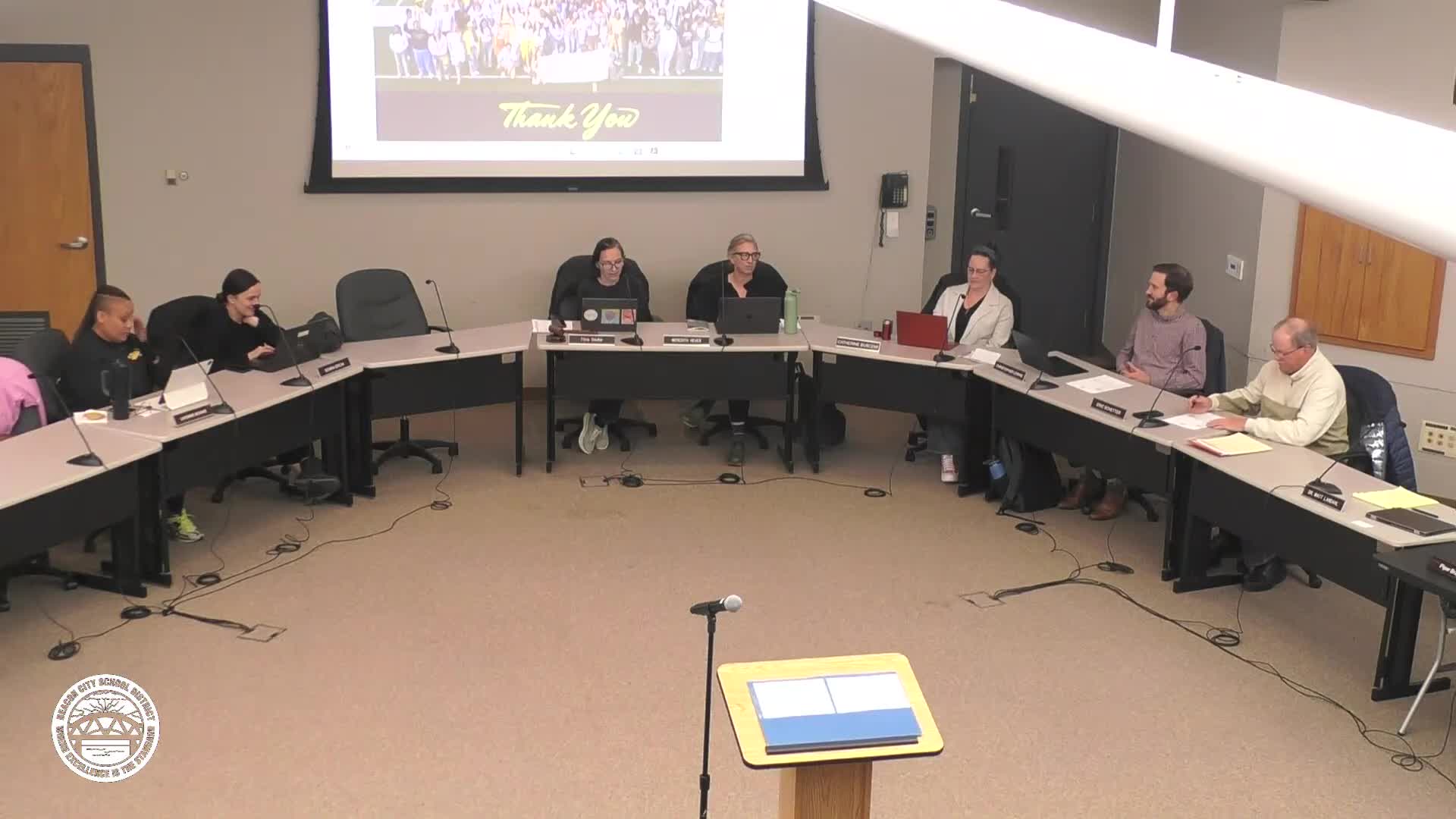
Summary
At its Nov. 17 meeting the Beacon City School District Board discussed a possible School Resource Officer (SRO) partnership with the City of Beacon. Superintendent Matt outlined national guidance, supervision and training concerns, and a rough all‑in cost estimate of about $100,000; trustees asked for community input and a budget plan before any decision.
The Beacon City School District Board spent much of its Nov. 17 workshop discussing whether to pursue a School Resource Officer (SRO) arrangement with the City of Beacon.
Superintendent Matt briefed the board on SRO guidance he said came from the National Association of School Resource Officers and a Department of Justice document, emphasizing four roles commonly described for SROs: "crime prevention and education, emergency manager, law enforcement problem solver, and informal counselor." He told trustees that a key implementation step is a memorandum of understanding with the partnering agency and ongoing community feedback: "This is probably the most crucial part of it in a sense, creating an, memo of understanding, an MOU," he said.
Matt stressed separation of roles in the guidance: "SRO should not be involved in disciplining students," he said, adding that serious incidents that require 911 remain outside routine school discipline. He contrasted an SRO with the district's current director of security role, pointing to overlap (liaison with police, event planning, lockdown drills) but also differences in supervision and legal relationships because an SRO would be employed by the city.
On costs Matt offered a ballpark estimate: an SRO arrangement that pays the person’s salary and benefits could run "around a $100,000 ish" once benefits and employer costs are included. He said many partnerships cover roughly 10 of 12 months in shared arrangements and that the district would need to determine whether to add new money to the security budget or restructure existing staff. Board members repeatedly returned to budget constraints and the district's roughly $1,000,000 security budget currently in place for staffing and services.
Trustees questioned operational details and next steps. Board members asked who would supervise an SRO on-site (Matt: the law-enforcement employer is the supervisor, with principals and the superintendent giving feedback), how incidents would be assessed, and whether an SRO would prevent problems or primarily respond to them. Several trustees said community input is essential; others emphasized they want any new role to fit within the current budget rather than replace multiple security positions.
The board did not vote. Instead members asked Matt to return at the December meeting with targeted follow-up: relevant studies on SRO effectiveness, a budget scenario showing how an SRO could be accommodated (or not) within the security budget, and outreach to the City of Beacon about capacity and timelines. The superintendent said he would seek community feedback and report back.
What happens next: the board expects an update in December with budget options, available SRO training timelines, and information on whether the city could staff and supervise the role before the board considers a formal direction or MOU.