Get email alerts on the Ai Energy topic
No spam. Unsubscribe anytime.
Witness at Joint Economic Committee: Energy may be the key constraint on U.S. AI leadership
Summary
At a Joint Economic Committee hearing, a witness said energy — not semiconductors or talent — may become the 'binding constraint' for advanced AI as compute and energy demand grow, urging better forecasting and planning for energy capacity.
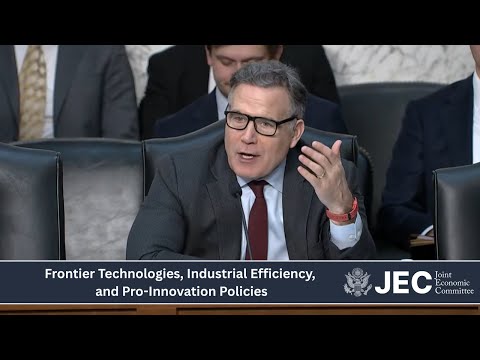
A witness at a Joint Economic Committee hearing warned that energy, not chips or talent, could limit the United States’ ability to scale advanced artificial intelligence.
The question came after a committee member cited testimony that "nearly 10% of U.S. businesses are utilizing artificial intelligence," a rate that "more than doubled from 2 years ago," and asked how "energy dominance" fits into a strategy for American leadership in AI. The witness responded that "the real binding constraint for compute" is energy and that "the input for AI really will be energy." The witness added that while the United States has semiconductors, talent and data, projections of future energy needs are "all over the board" and that the Energy Information Administration (EIA) is doing work that needs to be supplemented by better forecasting.
Why it matters: If compute demand for large-scale AI deployment outpaces available power, firms could face delays in training and operating models, raising costs and potentially shifting investment decisions. Committee members noted a broader policy implication: energy planning, grid capacity and permitting processes will need to be factored into industrial and innovation strategy.
No formal actions or votes were recorded during this portion of the hearing.
AI generated
The text on this page is AI generated. Summaries, highlights, analysis, and video transcripts are all produced from the original source material.
AI can make mistakes, so if you spot one, and we will fix it for everyone.
Note: the source content is unaltered by us. Any content source we link to, be it a video, an audio recording, or a document, is presented exactly as its publisher released it. That publisher is usually a government body, sometimes an individual official or another organisation.