Get Full Government Meeting Transcripts, Videos, & Alerts Forever!
Get email alerts on the Edit Plan topic
No spam. Unsubscribe anytime.
Council flagged by county auditor: EDIT capital plan set to expire, could sequester funds if not updated
Summary
The county—s economic development income tax (EDIT) capital plan expires Dec. 31, 2025. County counsel and auditor told council that, without a plan meeting statute (two years and 75% of projected EDIT revenue), the treasurer must hold future EDIT receipts in a separate account and funds could revert to other taxing units after three years.
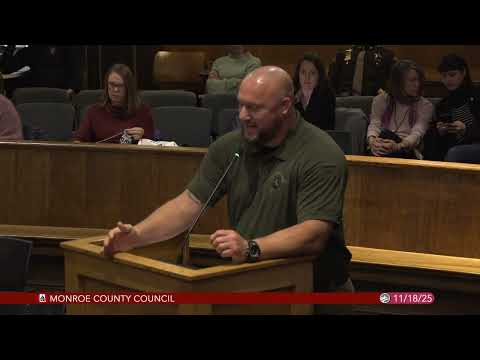
Monroe County Council spent a significant portion of its Nov. 18 meeting debating the status of the county—s economic development income tax (EDIT) capital improvement plan after the auditor—s office circulated a notice that the plan approved three years ago expires Dec. 31, 2025.
The issue: An email from county staff alerted council to an EDIT plan that, under Indiana law, must describe projects, costs, funding sources and timelines and must account for 75% of expected EDIT revenue over at least a two‑year horizon. Counsel and the county auditor said that if the county has no adopted plan for a year, the treasurer is required to retain EDIT distributions in a separate restricted account; if a unit fails to adopt a plan for three years the balance may be redistributed to other taxing units in the county.
What council discussed: Members reviewed the three‑year‑old plan (Exhibit A) and found it still lists a County Justice Center as the primary capital project with an original estimate of about $100 million. Several councilors noted the plan—s cost and revenue estimates are out of date and said the current budget already uses EDIT proceeds for 2026 operations (council budget line roughly $4,667,719 was mentioned). Auditor staff said the current EDIT cash balance is approximately $22.5 million and that a revised plan should include the 2026 budgeted uses and an updated timeline for the capital project.
Positions and next steps: Some council members framed the issue as a technical fix the commissioners could adopt to align the capital improvement plan with council's budget decisions. Counsel and the auditor said the commissioners are the body that adopt or designate a capital improvement plan but noted that spending EDIT proceeds without a proper plan could trigger the statutory hold. Several councilors said they would attend the Dec. 4 commissioners meeting to coordinate; others argued the county should update the plan promptly so the treasurer does not sequester funds.
Why it matters: If a council and commissioners do not adopt a compliant capital improvement plan in the statutory window, EDIT proceeds may be placed in a separate account or, after a longer lapse, redistributed to other taxing units. Council members emphasized the risk that planned 2026 expenditures tied to EDIT could be delayed or placed at risk without a current intergovernmental plan.
What the record shows: Council did not take an immediate binding vote on the EDIT plan itself during the Nov. 18 meeting; staff and counsel agreed to provide the council with hard copies of the existing plan and statutory language, and to coordinate next steps with the commissioners.