
East Stroudsburg policy committee debates striking six-week enrollment carve-out for absent students
Get AI-powered insights, summaries, and transcripts
Subscribe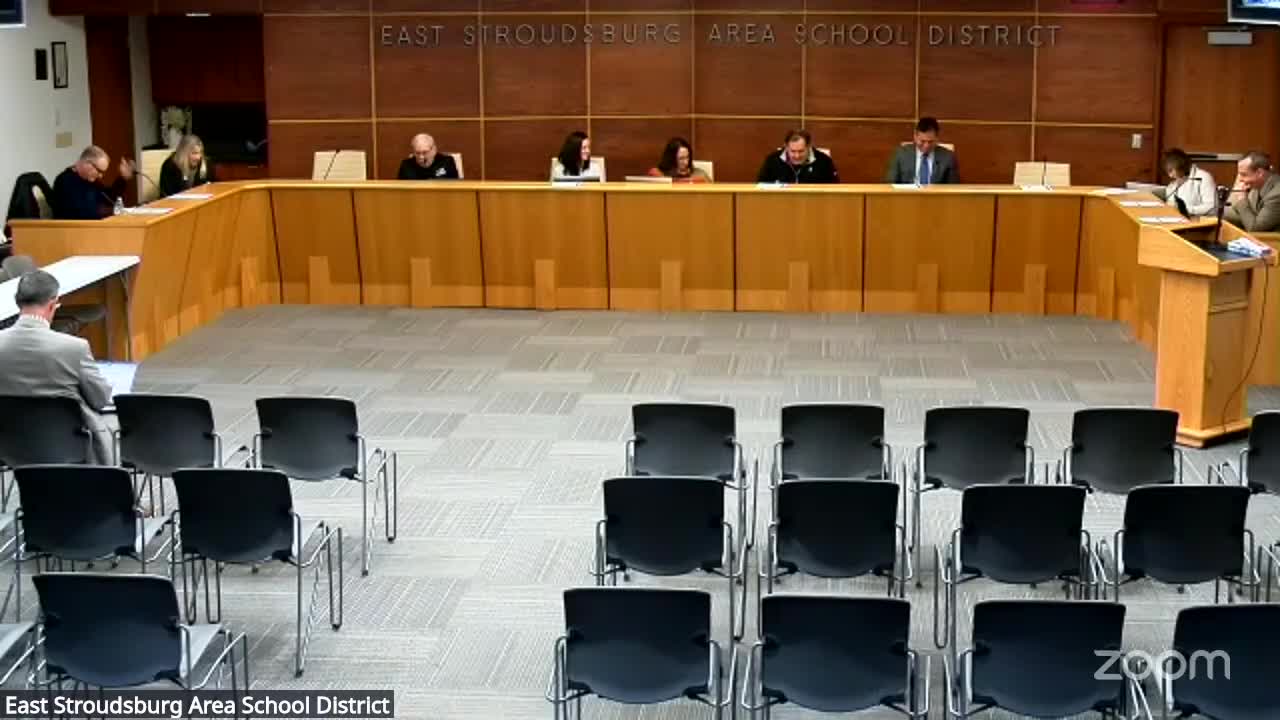
Summary
The policy committee debated proposed edits to Policy 202 that would remove a previous six‑week carve-out allowing some students to remain enrolled while temporarily absent; administrators said the change closes loopholes and aligns the district with state attendance rules and other policies, while board members urged an appeals path for documented hardships.
The East Stroudsburg Area School District policy committee spent the bulk of its Nov. 17 meeting debating proposed revisions to Policy 202 that would remove a paragraph allowing some nonresident or temporarily absent students to remain enrolled for up to six weeks.
Speaker 2 (Administrator) told the committee the provision “predates the current applications of our policy” and is being exploited to keep students on the rolls when they are not residing in the district. Speaker 2 said McKinney‑Vento protections already cover students who are homeless or in foster care and that state regulations allow a district to disenroll students after 10 consecutive unexcused days: “Unlawfully absent for 10 consecutive days, they have to be withdrawn unless we’re pursuing compulsory attendance,” Speaker 6 summarized.
Board members pressed for exceptions and clearer appeal language. Speaker 1 warned the change could deny needed help in emergencies and asked for “some kind of leniency” for families with temporary hardship, citing examples such as military relocations, bereavement, or urgent medical care out of state. Speaker 4 suggested the district could add language to clarify transitions to the district’s virtual program when families provide advance notice.
Administrators framed the revision as a fiscal and operational safeguard. Speaker 2 noted that when students register for an online platform such as Edgenuity, the district pays for that seat; routinely maintaining nonresident students on the rolls “impacts our truancy” and imposes recurring costs. Speaker 2 said the intent is not to be “unkind to children” but to ensure residency rules are applied consistently and that other policies already address educational instability.
Committee members proposed concrete fixes. Suggestions included aligning local wording with the state’s 10‑day automatic withdrawal point, explicitly preserving McKinney‑Vento protections, and adding an appeals or advance‑notice pathway so families can transition a student into the district’s virtual program when appropriate. No final change language was adopted at the committee level; administration recommended posting the draft for public review and returning to the full board in December.
The committee voted to post Policies 101, 202, 214 and 832 for public review, allowing the full board to review the proposed language and consider amendments at a later meeting.
Next steps: administration will post the policies for public comment during November and present them to the full board for action in December.