
St. Pete Beach advisory committee backs consolidated beach ordinance with edits
Get AI-powered insights, summaries, and transcripts
Sign Up Free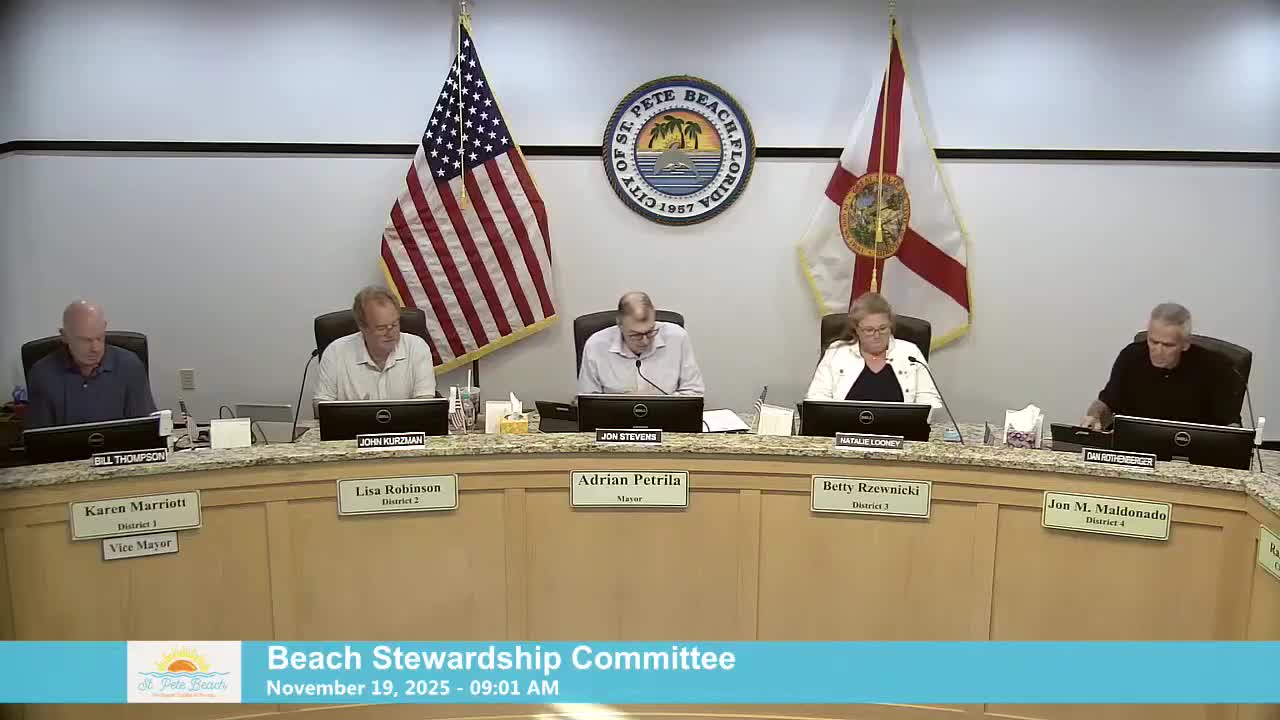
Summary
The Beach Stewardship Committee recommended a consolidated beach ordinance to the City Commission after debating sign rules, private vs. public beach land language, registration for commercial chair/cabana vendors, prohibitions on polystyrene/plastic straws and glass containers, micromobility rules, and wildlife protections.
The Beach Stewardship Committee voted to recommend a consolidated beach ordinance to the City Commission after a lengthy review of proposed rules covering signage, commercial operations, environmental protections and enforcement.
Brandon Berry, the city planner, presented the draft ordinance (referred to in the meeting as ordinance 2025‑02), which combines existing code sections and incorporates changes discussed in recent community forums. Key elements include a proposed registration system for enterprises that place chairs, umbrellas, cabanas or tables on the beach; limits on polystyrene on public beaches; a prohibition on certain single‑use plastic straws associated with food and beverage consumption (with staff noting pending state legislation may affect final language); and a ban on glass containers or bottles associated with consumption on the beach.
The ordinance also addresses signage posted on private beach land. City counsel described recent meetings with a private property owner who placed signs near the mean high water line and told the committee deputies said they could ‘‘triangulate’’ property lines rather than relying on signs at every corner. The owner had asked for a more blanket trespass policy; the sheriff’s office declined, citing prosecutorial discretion. Committee members worried about sign proliferation and the aesthetics and safety risks of more metal posts on the beach; staff proposed a pilot to remove the signs nearest the waterline and rely on sheriff response while the city considers a sign ordinance amendment.
Members debated the appropriate terminology for references to beach areas. Several urged consistent wording — ‘‘public beach land’’ and ‘‘private beach land’’ — and asked for an explicit recognition that customary‑use doctrine exists in Florida rather than language that might be read as endorsing private ownership of the beach.
Commercial operations were a frequent focus. Berry said the registration requirement would tie to business tax receipts for recurring vendors and give the city notice about enterprises operating on the public beach, but that dimensional standards and enforcement details (for example, whether chairs must be occupied to remain in place) could be addressed in later rulemaking. The committee asked staff to clarify whether business operators can place equipment on the public beach ahead of renting it and how unregistered activity would be enforced.
The draft prohibits bicycles and micromobility devices on the beach except when authorized through a special‑event permit; members split on that point. Vice Chair Kurzman argued for limited allowances and operational rules (seasonal bans in nesting season, speed limits and distance buffers), while other members described near‑collisions and safety complaints and supported a broader prohibition, with exceptions for permitted special events.
On wildlife and safety measures, the ordinance would prohibit chumming (feeding or baiting that draws predatory fish), require permits or registration for dune maintenance activities even when state agencies do not require them, and expand the mechanical beach‑cleaning permit season to align with nesting windows. Berry also proposed posting and permitting rules for fire pits and a year‑round (or, if the commission prefers, seasonal) ban on fireworks.
After discussion, the committee voted to recommend the ordinance to the City Commission with the edits discussed during the meeting. The roll call recorded Member Looney: yes; Member Rothenberger: yes; Member Thompson: yes; Vice Chair Kurzman: no; Chair Stevens: yes. The motion carried.