Get Full Government Meeting Transcripts, Videos, & Alerts Forever!
Get email alerts on the Fee Study topic
No spam. Unsubscribe anytime.
Advisory committee asked to weigh fee-study principles and special-event cosponsorships
Summary
City staff said an outside firm (Raftelis) is conducting a recreation fee study and asked the advisory committee for guidance on affordability, fairness and cost-recovery tiers; members pressed staff on EMS/sheriff requirements, a 250-person threshold and post-event reporting for cosponsored events.
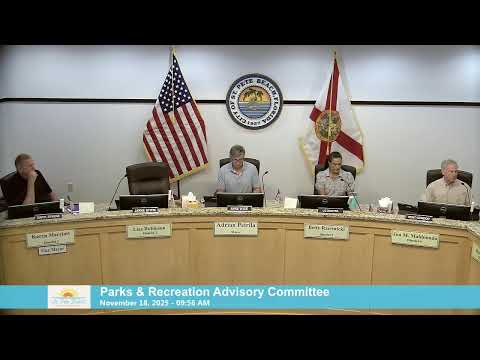
Unidentified recreation staff told the St. Pete Beach advisory committee on Nov. 18 that the city has engaged a consultant (Raftelis) for a citywide fee study focused first on recreation. Staff asked committee members to identify values that should guide fees — including affordability, fairness, cost recovery and equitable access — and said a more detailed presentation with numbers will be scheduled for a special January meeting.
Staff outlined a three-tier approach that will guide cost-recovery recommendations: Tier 1 for broad community benefit items (parks, playgrounds, trails) typically remains tax-funded; Tier 2 for mixed-benefit offerings such as leagues, classes and events carries a recommended cost-recovery target of about 70%; and Tier 3 for individual-benefit items (facility rentals, private lessons) targets full cost recovery. "Tier 2 is a mixed benefit ... recommended cost recovery at about 70%," staff said.
Committee members asked for the existing fee schedule to be circulated prior to the January meeting so they can gather neighborhood feedback. Staff agreed to provide the current fees and the consultant's recommendations in advance.
The committee also discussed the city's cosponsorship approach for special events. Staff described common cosponsorship practices — waiving the special-event permit fee, and in some cases covering EMS or sheriff costs — while event organizers remain responsible for insurance, hold-harmless agreements and site plans. Members pressed staff about inconsistent requirements: why large recurring operations such as the Corey Avenue Sunday Market routinely proceed without on-duty EMS/fire and why some neighborhood events were charged fees despite limited complexity. One committee member asked whether the 250-person threshold that can trigger EMS coverage is statutory and recommended the city collect post-event incident reports and financials for for-profit entities that receive fee waivers.
Staff said EMS and sheriff requirements are event-specific and often based on location, hours and anticipated attendance; the department will research whether the 250-person threshold is a statutory requirement and will revise the cosponsorship application based on committee feedback. Staff also said the city will open the cosponsorship application on Jan. 1 for nonprofits, and that the committee's suggested post-event reporting and clearer documentation would be considered when the city updates the packet.
Committee members emphasized balancing cost recovery with community access and quality-of-life benefits; one member urged keeping recovery targets lower for recreation to avoid discouraging participation and noted that pools and the library historically do not recoup full operating costs.
Staff set Jan. 20 as a tentative date for a special meeting to review the fee-study results and asked the committee to collect public feedback before that session.