Get Full Government Meeting Transcripts, Videos, & Alerts Forever!
Get email alerts on the Arts Grants Rulemaking topic
No spam. Unsubscribe anytime.
Florida Department of State pauses arts‑grant cycle, cites need to tighten scoring and comply with law
Summary
Secretary Byrd told the subcommittee the Division of Arts and Culture paused the 2026 grant cycle to revise guidance and scoring after nearly 800 applications requested more than $80 million while the Legislature appropriated $26 million; members raised concerns about potential effects on organizations with adult‑oriented programming.
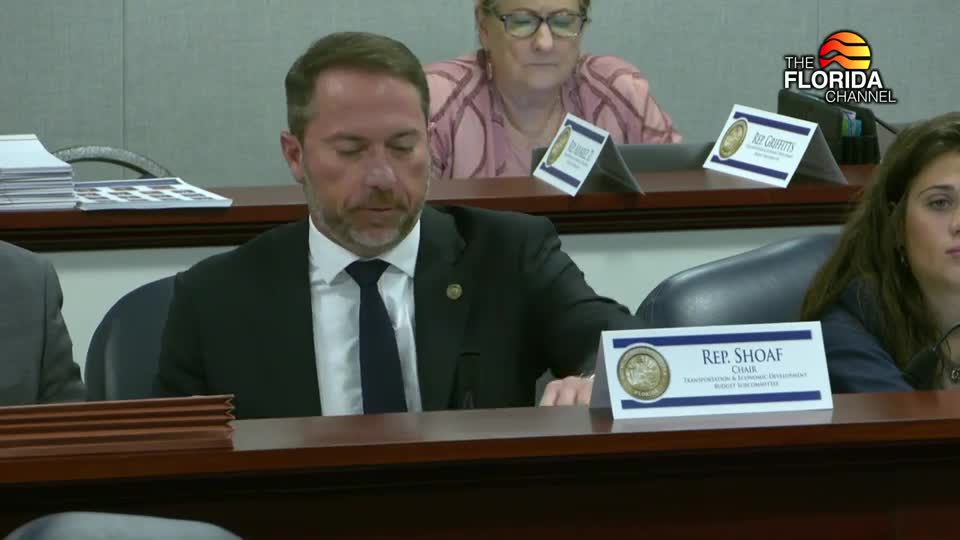
Secretary of State Cord Byrd told the Transportation and Economic Budget Subcommittee on Nov. 24 that the Division of Arts and Culture paused the 2026 cultural‑grants cycle to update guidance and scoring and that the rule governing the revisions was filed for adoption on Nov. 10, 2025.
Byrd said the division received nearly 800 applications seeking more than $80 million while the Legislature appropriated $26 million for the current cycle. To “maximize the impact” of limited funds, the department said it will focus on highest‑scoring applicants, educational value, support across communities and distribution to rural counties.
Byrd said the pause allowed staff to clarify expectations and scoring and that applicants may submit new or updated applications under the revised guidance. He told the committee recommendations will be provided to the Legislature during the upcoming session and that awards will be issued by July 1, 2026.
Representative Escamani and others pressed Byrd on the effect of the revised rules, particularly language that ties eligibility to compliance with chapter 847 (the state obscenity statute). Byrd said the department is exercising rulemaking authority granted by statute and that enforcing laws passed by the Legislature is part of the agency’s duty. Escamani warned the changes could effectively bar organizations from funding if venue‑level activities fall outside the revised criteria; Sandy Shaughnessy, the division director, said panels and the Florida Council on Arts and Culture will evaluate eligibility and that, per the proposed rule language, venue or organizational activities may be considered in eligibility determinations.
Escamani framed the change as a potential free‑speech or censorship risk; Byrd replied, “This is the appropriation of money. It is a grant. It is not an entitlement,” and said the administration must follow the law when awarding taxpayer funds. Committee members asked whether final rules would be subject to legislative review; Byrd said JAFSE had no comment on the rule and that the rulemaking process has proceeded.
A single public commenter, Sarah Dulinroy, chief executive officer of Young Actors Theatre, urged continued funding for the program, described the theater’s long record serving children and said her organization scored 94.5 on its application and narrowly missed the new threshold.
What’s next: Byrd said the division reopened online applications this week to accept updates, and that the department will deliver final recommendations to the Legislature during the upcoming session with awards set for July 1, 2026.