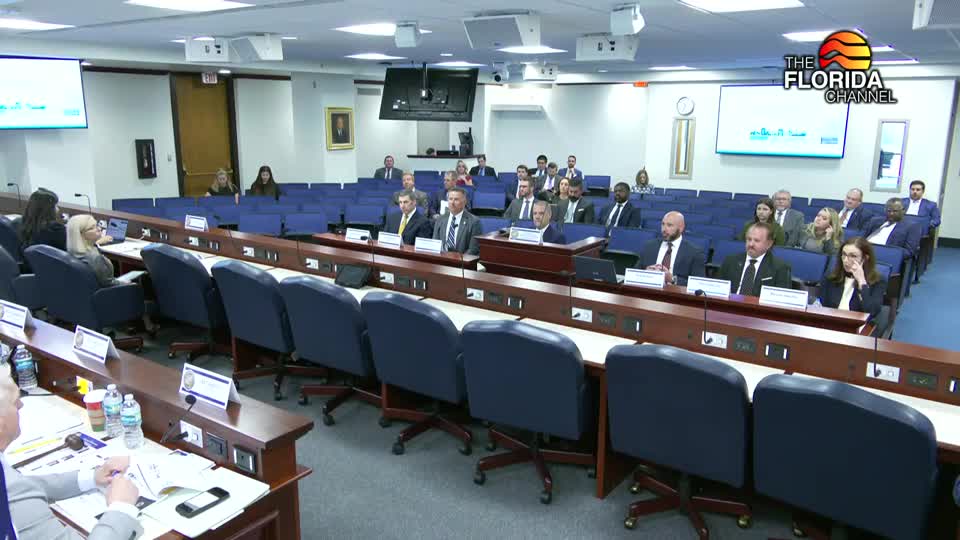
Natural gas industry officials tell House panel Florida supply is ample, point to pipeline integrity and RNG growth
Loading...
Summary
Industry witnesses told the Florida House Economic Infrastructure Subcommittee that natural gas currently supplies most of the state's electricity, that pipeline and storage capacity provide resilience during storms, and that renewable natural gas and transportation use are growing; members pressed witnesses on security, leak detection and FERC permitting timelines.
Dale Calhoun, executive director of the Florida Natural Gas Association, told the Economic Infrastructure Subcommittee that natural gas remains central to Florida's energy system and that the industry has expanded in recent years. "We now currently have approximately 1,000,000 metered customers," Calhoun said, describing growth from about 800,000 meters in six years and listing generation, industrial, commercial and residential end uses.
Calhoun said the industry contributes to state economic activity and tax revenue and emphasized storm-time reliability, saying recent hurricanes left most customers online and that most outages were brief. "Of the hurricanes of the last three years, we've been able to keep 99% of all of our customers online," he said. He added that distribution upgrades (replacing cast iron and bare steel with plastic) and routine maintenance have bolstered resilience.
Energy Transfer's Bob Pollock said Florida Gas Transmission (FGT) transports roughly 60% of the natural gas used in Florida and described the pipeline's network, storage locations and delivery points. Pollock told the committee that FGT currently moves about 3.2 billion cubic feet per day into the market area and that its storage sites can help manage short-term supply disruptions.
Pollock explained federal permitting pathways under the Federal Energy Regulatory Commission (FERC), noting three primary filing types and that larger projects require a Section 7(c) filing with the longest review timeline. He said there is a temporary cost threshold increase that will allow some projects to proceed under expedited procedures if completed by May 2027.
Industry witnesses described routine integrity and security practices. Pollock and other panelists said the pipeline industry uses inline inspection tools (commonly called "pigs"), aerial and satellite leak surveys, methane-detection vehicles and dedicated staff to locate and repair leaks. Pollock said pipeline maps and certain cybersecurity details are restricted and subject to federal limits on disclosure.
Panelists also discussed renewable natural gas (RNG) and the transportation market. Calhoun and others said RNG and compressed or liquefied natural gas (CNG/LNG) are growing uses, particularly for heavy fleets, refuse trucks and transit systems. Calhoun cited a national statistic that in 2023 about 79% of on-road CNG/LNG usage was from renewable natural gas, and panelists noted several Florida landfill and dairy projects that inject RNG into distribution systems.
Committee members focused questions on safety and security. Representative Franklin asked how the industry protects pipelines from criminal or terrorist acts; witnesses said most transmission lines run below ground or in rights-of-way, that above-ground exposure is limited, and that security is layered with physical patrols and cyber protections. Members also pressed on lining versus replacing older pipes; witnesses said lining is possible in some circumstances but depends on pipe age, pressure and condition.
The panel emphasized that nearly all of Florida's gas supply comes from out of state (shale and Gulf Coast basins), though speakers noted an expanding diversity of supply sources and that local RNG adds resilience. No formal votes occurred on policy during the session; the committee adjourned at the end of the agenda.
What happens next: committee members did not take formal action on legislation at this meeting. Industry witnesses said pipeline expansions and projects continue under FERC review timelines, and members said they may follow up on security, municipal utility record protections and permitting questions.